
Massive Boost to Indian Farmers
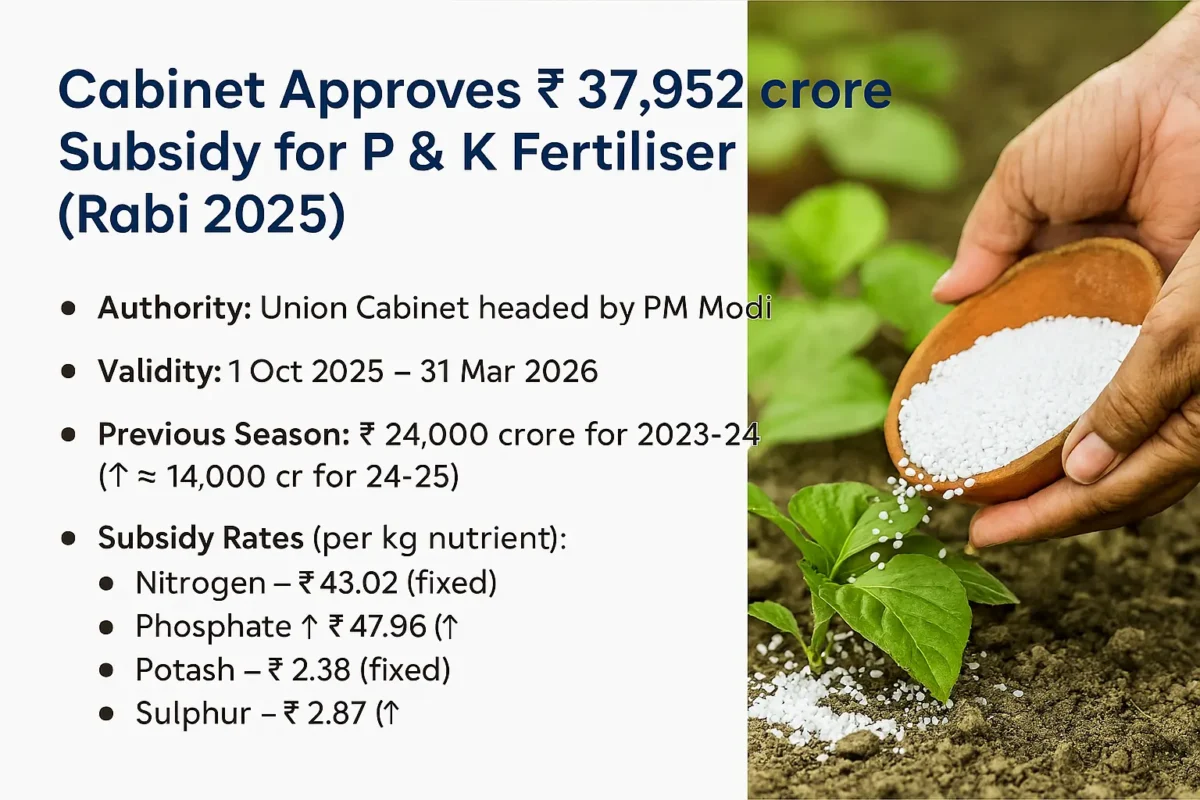
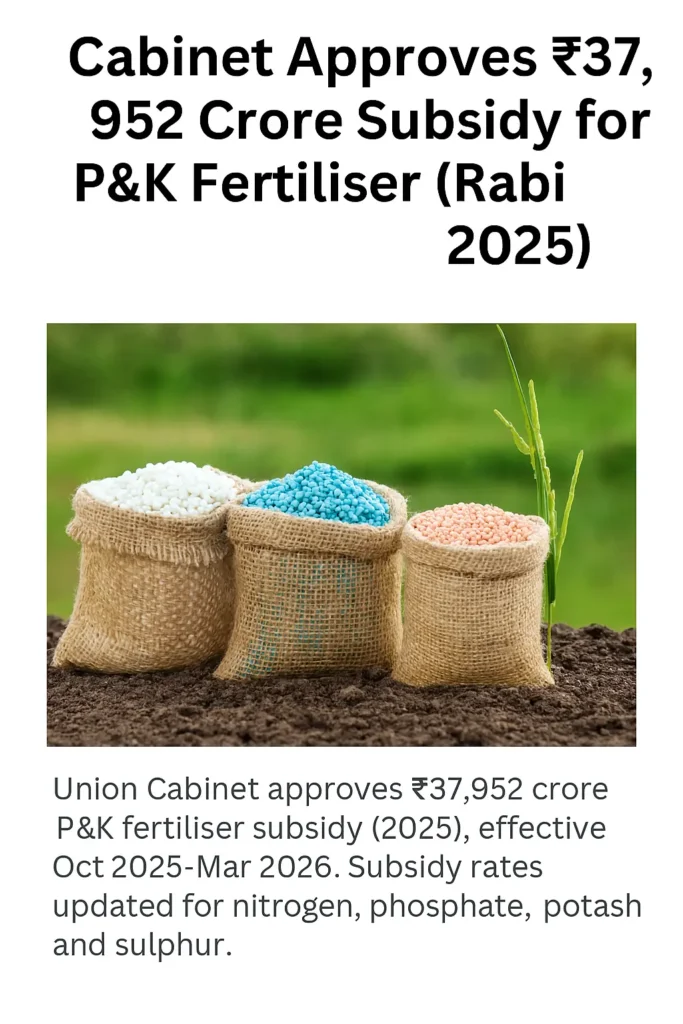
In a significant move to support India’s agricultural ecosystem, the Union Cabinet, chaired by Prime Minister Narendra Modi, has approved a ₹37,952 crore subsidy for Phosphatic and Potassic (P&K) fertilisers under the Nutrient-Based Subsidy (NBS) Scheme for Rabi 2025-26.
The initiative ensures the continued availability of essential fertilisers at affordable rates, strengthening India’s commitment to food security and farmer welfare. Press Information Bureau Release
📅 Validity: October 1, 2025 – March 31, 2026
Key Highlights of the Subsidy Package–
Updated Subsidy Rates (per kg nutrient):
- Nitrogen (N): ₹43.02 (unchanged)
- Phosphate (P): ₹47.96 ⬆️ increased
- Potash (K): ₹2.38 (unchanged)
- Sulphur (S): ₹2.87 ⬆️ increased
🧪 About the NBS Scheme
The Nutrient-Based Subsidy Scheme encourages balanced fertilisation and curbs the overuse of urea by linking subsidies to nutrient content (N, P, K, S) rather than fertiliser type.
Benefits for farmers:
- Flexibility in choosing fertiliser brands and blends
- Affordable access to essential nutrients
- Improved soil health through balanced nutrient use
- Transparent pricing and reduced market distortion
For more details:
👉 Department of Fertilisers – NBS Scheme
👉 Ministry of Chemicals and Fertilisers
Why the Increase in Subsidy?
The government revised subsidy rates to counteract:
- Volatile global raw-material prices (phosphate rock, sulphur, ammonia)
- Rising import costs for DAP and NPKS fertilisers
- Commitment to food security and welfare of small & marginal farmers
This adjustment ensures price stability while supporting India’s goal of self-reliance in fertiliser production.
🌱 Impact on Farmers
- Lower input costs: Farmers save significantly per bag of fertiliser.
- Timely availability: Subsidy ensures adequate domestic supply.
- Higher productivity: Balanced nutrient use improves soil fertility.
- Support for smallholders: Reduces dependency on costly imports.
Example:
A 50 kg bag of DAP (18% N, 46% P) under new rates will get approx.
- N Subsidy = 18 × ₹43.02 = ₹774.36
- P Subsidy = 46 × ₹47.96 = ₹2,206.16
➡️ Total subsidy per bag = ~₹2,980.52

Government’s Long-Term Vision
The fertiliser subsidy aligns with India’s broader agricultural reforms:
- Doubling farmers’ income by promoting productivity and efficiency
- Encouraging sustainable agriculture through balanced nutrient use
- Strengthening domestic manufacturing of fertilisers
- Enhancing self-reliance (Atmanirbhar Bharat) in the agri sector
Union Minister Ashwini Vaishnaw stated that rates were set considering global market fluctuations and nutrient demand, maintaining a balance between affordability and fiscal prudence.
Subsidy Comparison: Rabi 2023-24 vs Rabi 2025-26
| Season | Subsidy (₹ crore) | Notable Changes |
|---|---|---|
| Rabi 2023-24 | ₹24,000 crore | Lower P & S rates |
| Rabi 2025-26 | ₹37,952 crore | Higher P & S rates; larger allocation |
Source: Press Information Bureau – Fertiliser Subsidy Updates
How It Strengthens India’s Agri Ecosystem
- Reduces price burden on farmers amid global uncertainty.
- Encourages scientific nutrient management and precision farming.
- Promotes domestic fertiliser production under the Make in India initiative.
- Improves soil quality and long-term agricultural sustainability.
- Supports food security, ensuring smooth Rabi sowing for major crops like wheat, mustard, and gram.
Key Government Initiatives Linked to NBS
- Soil Health Card Scheme – promoting balanced nutrient use.
- Pradhan Mantri Krishi Sinchayee Yojana (PMKSY) – efficient irrigation for better yields.
- Digital Agriculture Mission – integrating data analytics in fertiliser management.
These complementary schemes ensure nutrient security, smart resource utilisation, and digital traceability in the agri-value chain.
For Auto Upates Visit – @motormitra


Expert Insight
Agriculture economists note that the ₹37,952 crore subsidy reflects a pro-farmer fiscal stance, ensuring that fertiliser affordability doesn’t become a bottleneck in food production. It also incentivises innovation in the fertiliser sector, encouraging companies to develop eco-friendly nutrient solutions.
Conclusion
The Union Cabinet’s decision to allocate ₹37,952 crore for P&K fertilisers under the Rabi 2025-26 NBS Scheme underscores India’s commitment to farmer welfare, soil health, and national food security.
By maintaining price stability and nutrient balance, the government ensures a resilient agricultural supply chain capable of withstanding global shocks.
This move not only supports millions of Indian farmers but also strengthens the foundation for a sustainable, self-reliant, and productive agriculture ecosystem. Nutrient Management in India – FAO Report
For more such updates and latest news on cars and bikes stay connected to times.motormitra.in
Thank you ..