
Tata Motors Reports ₹867 Crore Loss After Demerger
Tata Motors, now representing the commercial vehicle (CV) arm following its landmark demerger, reported a consolidated net loss of ₹867 crore for the quarter ended September 2025, compared to a profit of ₹498 crore in the same period last year. The loss, announced on Thursday, November 13, comes shortly after Tata Motors’ historic relisting on the BSE and NSE on November 12, 2025, marking the first standalone performance of the CV entity since the corporate split.
According to company filings, the decline was primarily driven by mark-to-market losses worth ₹2,026 crore on its recently listed investment in Tata Capital, even as operational metrics remained strong.
Revenue Growth Despite Net Loss (Tata Motors)
Despite the headline loss, Tata Motors’ revenue from operations grew 6% year-on-year, rising to ₹18,585 crore from ₹17,535 crore in Q2 FY25. The company’s profit before tax (PBT) stood at ₹1,694 crore, up from ₹1,225 crore in the same quarter last year, demonstrating strong performance in its core commercial vehicle business.
The EBITDA margin improved to 12.2%, an increase of 150 basis points (bps) compared to last year, while the EBIT margin climbed to 9.8%, driven by volume recovery, favorable pricing, and cost optimization efforts. Tata Motors’ domestic sales volumes rose 9% year-on-year, while exports surged 75%, supported by demand recovery in Africa and the Middle East. Overall, wholesales reached 96,800 units, contributing to a 12% year-on-year growth in total volumes.
Also Read – Paul Kapur Appointed US Assistant Secretary | South & Central Asia
CEO Comments: Demand Recovery and GST Impact
Commenting on the results, Girish Wagh, Managing Director & CEO of Tata Motors, said:
“After a subdued start to the quarter, the rollout of GST 2.0 and the onset of the festive season catalysed a surge in demand across most commercial vehicle segments. Construction, infrastructure, and mining activities are showing steady improvement, creating a favorable outlook for H2 FY26.”
He added that the company’s focus on cost discipline, premiumization of products, and aftermarket expansion helped offset the financial impact of mark-to-market losses.
Post-Demerger Business Landscape
The September quarter marked Tata Motors’ first standalone financial results following the corporate demerger, which became effective on October 1, 2025.
Under the restructuring:
- The commercial vehicle division retained the Tata Motors Limited name.
- The passenger vehicle and EV business now operates independently as Tata Motors Passenger Vehicles Ltd. (TMPV).
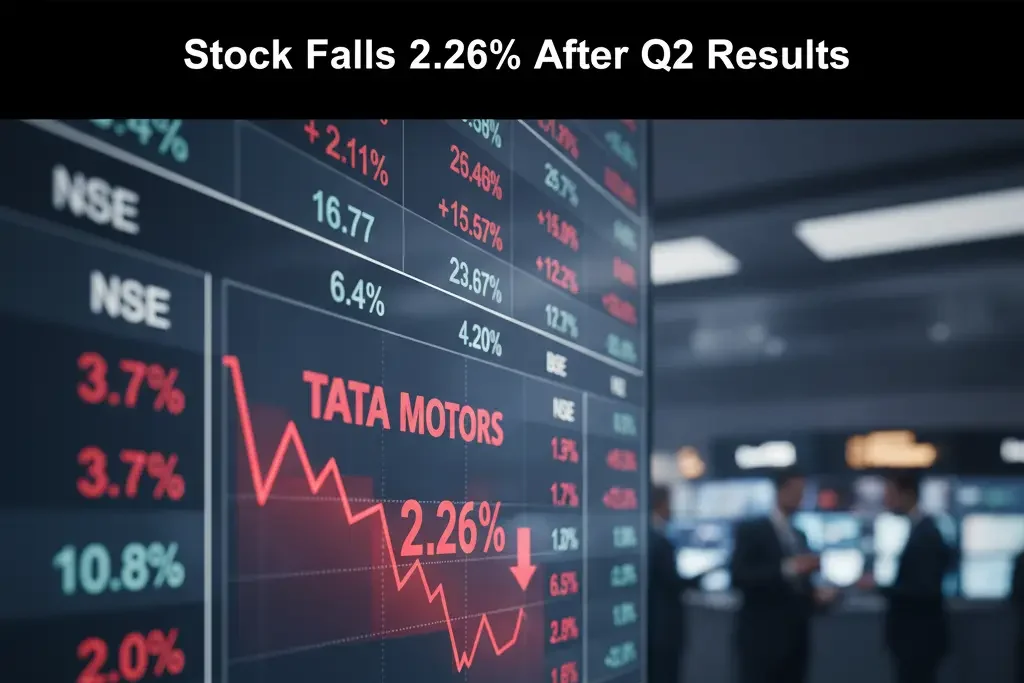
The CV entity’s listing on November 12, 2025, was met with strong investor enthusiasm, debuting at a 28% premium over its reference price. However, shares corrected after the earnings announcement, closing 2.26% lower at ₹320.25 on November 13. Analysts noted that while the mark-to-market impact on Tata Capital temporarily pressured the bottom line, core operational performance remained robust and in line with expectations.
Financial Snapshot (Q2 FY26)
| Metric | Q2 FY26 | Q2 FY25 | Change |
|---|---|---|---|
| Revenue (₹ crore) | 18,585 | 17,535 | +6% |
| Net Profit/Loss (₹ crore) | -867 | +498 | — |
| EBITDA Margin | 12.2% | 10.7% | +150 bps |
| EBIT Margin | 9.8% | 8.3% | +150 bps |
| Domestic Volumes | +9% YoY | — | — |
| Export Volumes | +75% YoY | — | — |

Also Read – OpenAI Launches AI-Powered Atlas Browser to Rival Google Chrome
Acquisition and Global Expansion Plans
Tata Motors also reaffirmed progress on its proposed €3.8 billion acquisition of IVECO, the Italian commercial vehicle manufacturer. Announced in July 2025, the acquisition is currently undergoing regulatory approvals and is expected to close by April 2026.
Once completed, the deal will significantly strengthen Tata Motors’ global footprint, expanding its topline to an estimated $24–25 billion and adding advanced European technology capabilities to its portfolio. The company plans to leverage IVECO’s expertise in heavy-duty trucks and electric commercial vehicles to fast-track its transition toward clean mobility.
Looking ahead to H2 FY26, Tata Motors expects sustained growth momentum on the back of:
✅ Higher fleet utilization post-GST 2.0 rollout
✅ Festive and infrastructure-driven demand
✅ Stronger financing availability
✅ Export recovery in key international markets
The management has guided for a continued double-digit EBITDA margin and expects FY26 to deliver higher free cash flow supported by cost control and demand normalization. “Tata Motors is well-positioned to capture long-term value across the commercial mobility spectrum — from ICE to electric platforms,” said Wagh. “We will continue investing in innovation, sustainability, and customer-centric solutions to drive future growth.”
Official Links
- 🔗 Tata Motors Official Website
- 🔗 Business Standard – Tata Motors Q2 Results Report
- 🔗 Economic Times Auto – Tata Motors Commercial Vehicle Update
- 🔗 Outlook Business – Tata Motors Post-Demerger Performance
Conclusion
The ₹867 crore quarterly loss underscores the one-time financial impact of Tata Motors’ demerger and investment exposure. Yet, the company’s solid operational results, margin expansion, and volume growth highlight a strong recovery trajectory in India’s commercial vehicle market. As Tata Motors embarks on its next chapter as a standalone CV powerhouse, the combination of robust fundamentals, global partnerships, and strategic clarity positions it for sustainable long-term growth.
Thank you for reading. Don’t forget to subscribe for more coverage!