
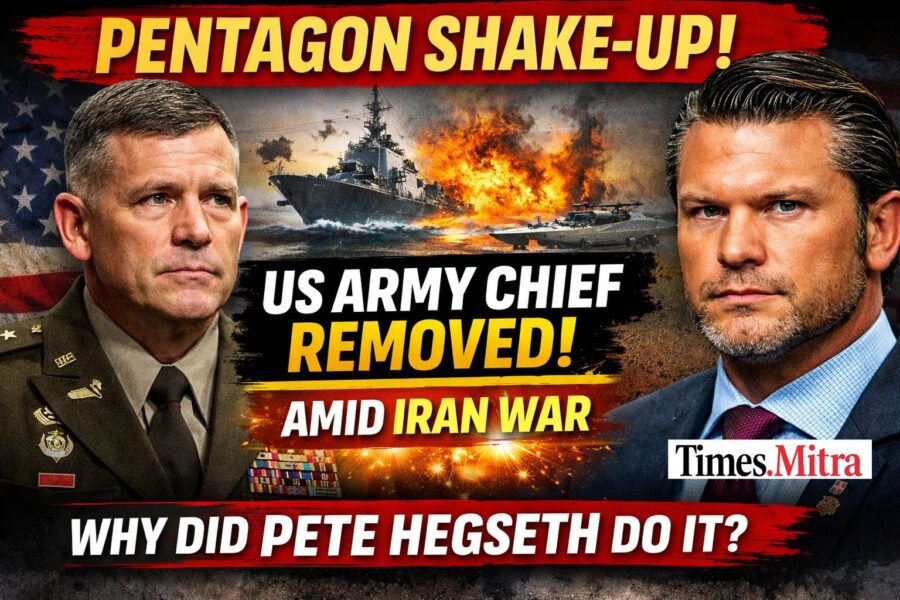
US Army Chief Forced to Step Down Amid Iran War
In a major and unexpected development within the United States military, Defence Secretary Pete Hegseth has asked the Army’s top officer, Randy George, to step down with immediate effect. The move has come at a highly sensitive time, as the US continues to remain engaged in escalating tensions and military activity involving Iran.
General Randy George, who took charge as Chief of Staff of the US Army in 2023, was responsible for overseeing global operations, troop readiness, and strategic planning. His tenure was expected to continue for a longer duration, making his sudden removal both surprising and controversial. The Pentagon has confirmed his exit but has not provided any clear explanation behind the decision.
Also Read: Big Surprise! New-Gen Kia Seltos Hybrid Debuts with AWD & 1.6L Engine: What India Will Get in 2027
What makes this development particularly significant is its timing. The United States is currently involved in a complex military situation in the Middle East, with thousands of troops deployed across key locations. In such circumstances, continuity in leadership is generally considered critical to maintain operational efficiency and coordination. Abrupt changes at the top level can potentially disrupt command flow and create uncertainty within military ranks.
Adding to the significance of this decision is the fact that General George is not the only senior officer to be removed. Reports suggest that David Hodne and William Green have also been asked to step down. This indicates that the move may be part of a broader restructuring effort within the Pentagon rather than an isolated action.

Following George’s exit, Christopher LaNeve has been appointed as the acting Chief of Staff of the Army. His appointment appears to signal a shift toward leadership that aligns more closely with the current administration’s strategic vision. LaNeve is considered a trusted figure and his rapid elevation suggests that internal realignment may be underway at the highest levels of military command.
Despite the magnitude of these changes, the lack of transparency remains a key concern. The Pentagon has not officially stated any reason for removing General George. While speculation ranges from policy disagreements to differences in military strategy, no confirmed details have been made public. This absence of clarity has led to increased debate and scrutiny.
From a strategic standpoint, changing top military leadership during an active conflict is seen as a high-risk move. Defence experts argue that such decisions can have ripple effects on operational stability, especially in a region as volatile as the Middle East. Coordination with allies, real-time decision-making, and battlefield strategies could all be impacted by sudden leadership transitions.
Politically, the move has also sparked discussions around the potential reshaping of military leadership. Critics believe that frequent removals of senior officers could indicate increasing political influence within the armed forces. On the other hand, supporters argue that such changes may be necessary to bring reforms and ensure alignment with evolving national security priorities.
This development also fits into a broader pattern observed during Pete Hegseth’s tenure as Defence Secretary. Over the past few months, there have been multiple leadership changes, policy adjustments, and structural shifts within the Pentagon. These actions suggest an ongoing effort to redefine how the US military operates and responds to global challenges.
In conclusion, the sudden removal of General Randy George is not just a routine leadership change—it reflects a deeper transformation within the US defence system. At a time when the country is navigating a sensitive geopolitical situation involving Iran, such decisions carry significant strategic and political weight.
The coming days will be crucial in determining the impact of this move. Whether it strengthens military effectiveness or introduces instability remains to be seen. However, one thing is clear: the United States military is currently undergoing a phase of significant transition, and its consequences could extend far beyond its borders.
For the latest tech and news updates stay connected to Times Mitra: https://times.motormitra.in/