
By Times Mitra | April 7, 2026
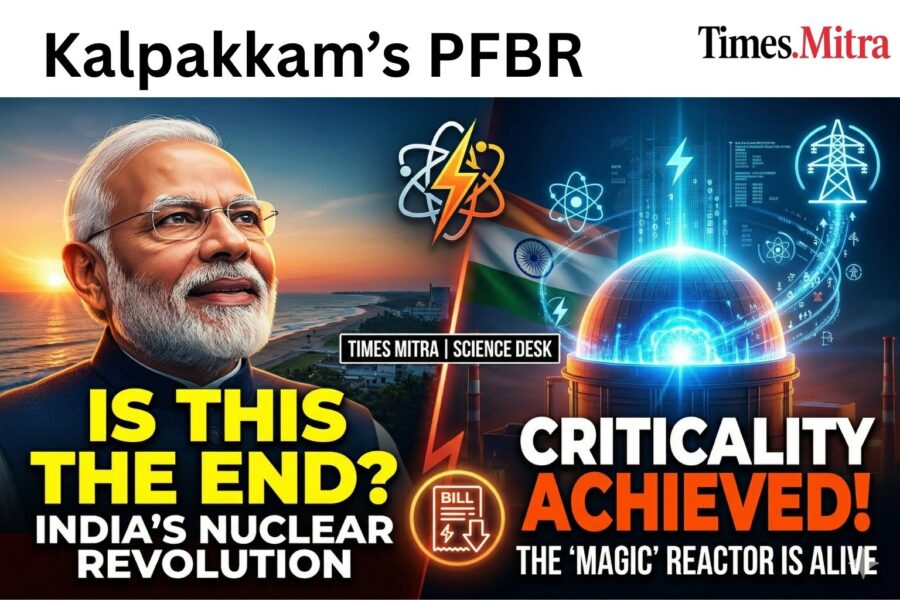
In a development that may redefine India’s long-term energy trajectory, the Prototype Fast Breeder Reactor (PFBR) at Kalpakkam has officially achieved criticality. This moment — technical, silent, and largely invisible to the public eye — represents one of the most consequential scientific milestones in India’s post-independence history.
After nearly two decades of engineering effort, regulatory scrutiny, and incremental progress, the reactor has crossed the threshold from infrastructure to functionality. Prime Minister Narendra Modi termed it a “defining step” in India’s nuclear journey — and the characterization is not without merit.
Understanding ‘Criticality’: When a Reactor Comes Alive
At its core, criticality marks the point at which a nuclear reactor sustains a controlled chain reaction without external intervention. On April 6, scientists at BHAVINI initiated this self-sustaining process inside the 500 MWe PFBR — effectively activating the reactor’s energy-generating potential.
Unlike conventional milestones such as inauguration or commissioning, criticality is a deeply scientific event. It signifies that the physics works, the design holds, and the system is stable. In essence, the reactor is now operational in principle — electricity generation will follow in subsequent phases.
A Rare Club — And India’s Strategic Entry
With this achievement, India joins a highly exclusive group. Only Russia has successfully deployed a commercial-scale Fast Breeder Reactor at this level. This is not merely symbolic. Fast breeder technology represents the frontier of nuclear energy engineering, offering solutions to two of the sector’s most persistent challenges:
- Fuel scarcity
- Long-term sustainability
India’s entry into this domain signals a transition from being a nuclear energy adopter to a technology leader.

Also Read: Iran Strikes Israel and Kuwait After Rejecting Trump Ultimatum: Global Economic Impact 2026
The Breeder Logic: Producing More Than It Consumes
What makes the PFBR fundamentally different is its ability to “breed” fuel. Traditional reactors consume fissile material such as uranium. In contrast, breeder reactors convert non-fissile isotopes into usable fuel — effectively multiplying their energy potential.
This capability is central to India’s three-stage nuclear program, particularly the second stage, which lays the groundwork for a thorium-based future. In strategic terms, it transforms nuclear power from a finite resource model into a self-sustaining energy ecosystem.
India’s nuclear roadmap has always been shaped by its unique resource profile. While uranium reserves are limited, the country possesses one of the world’s largest thorium deposits. The PFBR is the critical bridge that enables this transition. By generating plutonium and facilitating advanced fuel cycles, it unlocks the possibility of:
- Large-scale thorium utilization
- Reduced import dependency
- Multi-century energy security
In a world increasingly defined by resource competition, this is a profound strategic advantage.
Real Implications for the Power Grid
For the average Indian household, nuclear milestones often appear abstract. Yet their implications are tangible. India’s growing economy demands stable, uninterrupted electricity — something renewable sources alone cannot guarantee due to intermittency. Nuclear energy, particularly breeder technology, offers:
- Baseload stability to complement solar and wind
- Cost efficiency over time, due to fuel regeneration
- Carbon-free generation, aligning with India’s net-zero ambitions
In effect, PFBR strengthens the backbone of India’s future energy mix.No nuclear milestone is complete without scrutiny on safety — and rightly so.
The Kalpakkam PFBR incorporates advanced passive safety systems, designed to function even in the absence of human intervention or external power. Its use of liquid sodium as a coolant enhances thermal efficiency, though it also introduces operational complexity requiring rigorous safeguards.
Indian nuclear authorities maintain that the reactor adheres to international safety benchmarks, reflecting lessons learned from global nuclear incidents. Beyond science, the PFBR represents a triumph of domestic capability.
Over 200 Indian industries, including numerous MSMEs, contributed to its construction — spanning precision engineering, materials science, and heavy manufacturing. This collaborative ecosystem underscores a broader narrative: India is not merely consuming advanced technology — it is increasingly building it at scale.
The government’s long-term target of 100 GW nuclear capacity by 2047 now appears more attainable. The Kalpakkam reactor is not the culmination of a project — it is the starting point of a scalable model. Replication, standardization, and cost optimization will be key to translating this success into a nationwide nuclear expansion.
PM Modi’s statement captures both the symbolism and substance of the moment:
“This advanced reactor reflects the depth of our scientific capability and the strength of our engineering enterprise.”
It is a message aimed not just at domestic audiences, but at the global community — positioning India as a serious player in next-generation nuclear technology.
The achievement of criticality at Kalpakkam may not dominate public discourse in the way elections or markets do. Yet its implications are arguably far more enduring.
It marks:
- A shift toward energy sovereignty
- A step closer to climate commitments
- A demonstration of technological maturity
Whether this moment ultimately resolves India’s energy challenges will depend on execution in the years ahead. But one conclusion is already clear:
India’s nuclear future is no longer theoretical — it has begun.
For the latest tech and news updates stay connected to Times Mitra: https://times.motormitra.in/