
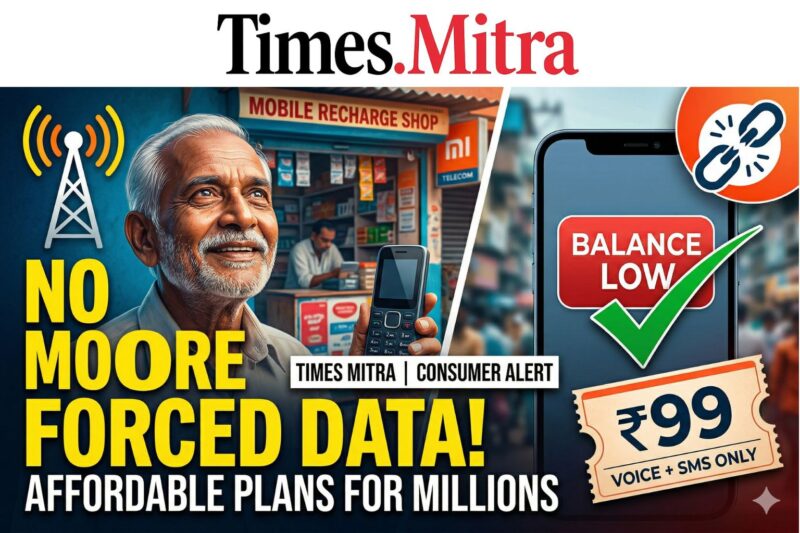
In a move that has sent shockwaves through the headquarters of India’s telecom giants, the Telecom Regulatory Authority of India (TRAI) has officially proposed a radical shift in how mobile plans are sold in the country. For years, Indian consumers have felt trapped in a “Data-First” ecosystem where even the most basic recharge plans are bundled with daily 4G or 5G data limits that many users simply do not need. Today, that is set to change. TRAI’s latest recommendation mandates that every telecom operator—including Reliance Jio, Bharti Airtel, and Vodafone Idea—must offer standalone voice and SMS-centric plans at significantly lower price points. This isn’t just a regulatory update; it is a long-awaited “Consumer Independence Act” for the Indian mobile user.
The Problem with the ‘Unlimited’ Illusion
For the past half-decade, the Indian telecom market has been defined by the “Unlimited Data” war. While this helped India become a global leader in mobile data consumption, it inadvertently marginalized a massive segment of the population. Senior citizens who only use their phones for family calls, rural users who lack high-end smartphones, and even budget-conscious urbanites have been forced to pay for 1.5GB or 2GB of daily data just to keep their SIM cards active.

TRAI’s intervention comes after analyzing thousands of consumer complaints regarding the vanishing of “Entry-Level” recharges. Currently, the minimum cost to keep a mobile number active has crept up to nearly ₹155 to ₹199 per month. For a family of four on a tight budget, that’s an essential expenditure that competes with the price of milk or electricity. By proposing a mandatory voice-and-SMS-only plan, TRAI is effectively demanding that telcos stop “forcing” data down the throats of those who don’t want it.
A Return to Basics: What the New Plans Look Like
The proposed framework is simple yet revolutionary. TRAI wants a dedicated category of plans that focus strictly on connectivity rather than consumption. These plans are expected to include unlimited local and STD calling and a standard set of 100 SMS per day, with zero or minimal data (perhaps just enough for basic WhatsApp text messaging).
Speculation within the industry suggests that if these recommendations are enforced, we could see the return of the sub-₹100 recharge. A monthly plan priced between ₹79 and ₹99 could once again become a reality. This would be a massive relief for India’s 2G and 3G legacy users—estimated to be over 200 million people—who are currently being pushed to upgrade to 4G/5G plans they cannot afford or use.
The Telco Tussle: Why Jio and Airtel are Worried
While consumers are cheering, the stock markets are watching the telecom operators with a wary eye. The Indian telecom sector has just recently recovered from a decade of price wars and debt. The current business model relies heavily on ARPU (Average Revenue Per User). Operators have been aggressively trying to push ARPU from ₹180 toward the ₹300 mark to fund their massive 5G rollouts.

Mandatory low-cost plans threaten this growth trajectory. If a significant percentage of “Low-Value” users downgrade from a ₹239 data plan to a ₹99 voice plan, the revenue hit could be substantial. Industry insiders argue that this could slow down 5G expansion in rural areas. However, TRAI’s counter-argument is centered on “Digital Inclusion.” The regulator believes that communication is a basic right, and users should not be “taxed” for data services they do not utilize.
The Hidden Impact on Portability and Spam
One of the most interesting aspects of this proposal is its impact on Mobile Number Portability (MNP) and essential SMS services. Currently, many users find it impossible to port their number out of a network because they haven’t recharged with a high-value “SMS enabled” plan. By making SMS a mandatory part of low-cost plans, TRAI is ensuring that the right to switch operators remains accessible to the poorest sections of society.
Furthermore, this move might indirectly help in the fight against financial fraud. Many low-income users miss out on critical banking alerts or Aadhaar-linked OTPs because their “Incoming” services are barred due to the lack of an expensive recharge. A low-cost mandatory plan ensures that the “Digital Identity” of a citizen remains active and secure, regardless of their financial status.
The Future of the Indian Telecom Market
If the Department of Telecommunications (DoT) gives the green light to this TRAI proposal, we are looking at a “Two-Tier” telecom market. On one side, we will have premium, high-speed 5G data bundles for the digital-first generation. On the other, we will have a robust, affordable, and government-mandated “Universal Connectivity” tier.
For the “Times Mitra” reader, the takeaway is clear: the era of “One Size Fits All” in telecom recharges is coming to an end. Whether you are a student looking to save money or a caregiver managing a phone for an elderly parent, more choices are on the horizon. The next time you open your banking app to recharge, you might finally see a button that says “Voice Only”—and your wallet will thank you for it.
For the latest tech and news updates stay connected to Times Mitra: https://times.motormitra.in/