
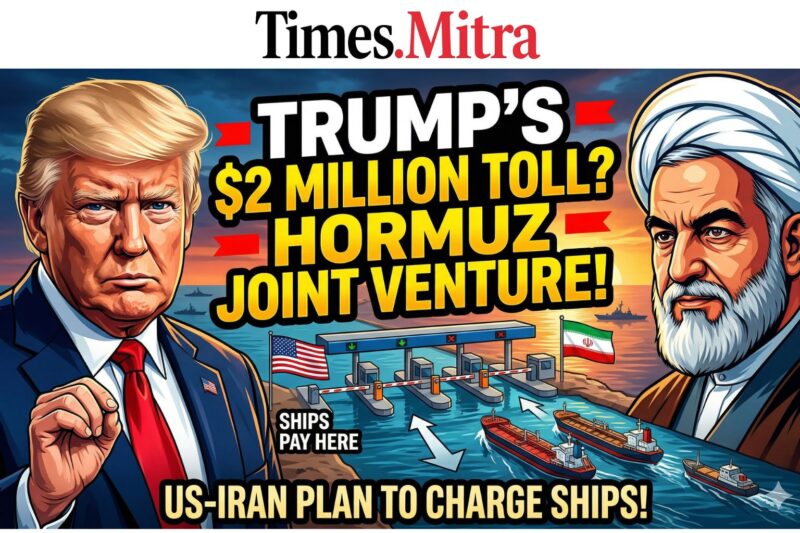
In a development that has sent shockwaves through global markets and diplomatic circles, U.S. President Donald Trump has proposed an unprecedented “joint venture” with Iran. The plan? To charge a mandatory toll on every ship passing through the Strait of Hormuz, one of the world’s most vital maritime chokepoints.
Coming on the heels of a fragile two-week ceasefire mediated by Pakistan, this proposal marks a radical shift from military confrontation to a controversial commercial partnership. Trump, in his characteristic style, has described the idea as “a beautiful thing,” suggesting that the U.S. and Iran could co-manage the waterway to ensure security—and generate massive revenue.
The $2 Million “Safe Passage” Fee: How It Works
Reports indicate that the proposed toll system isn’t just a minor administrative fee. Iran has reportedly already begun floating figures as high as $2 million per vessel for safe passage.

Also Read: Kalpakkam’s PFBR Achieves Criticality — A Quiet Revolution with Global Implications
Why the Toll?
- War Reparations: Iran views these fees as a way to fund the reconstruction of infrastructure damaged during recent hostilities.
- Joint Control: Trump suggests a joint U.S.–Iran system would “secure it from lots of other people,” effectively turning the Strait into a private, high-security corridor.
- Economic Leverage: For the U.S., it’s a way to ensure American interests are compensated for “policing” the region.
A “Fragile Peace” and a Sudden Pivot
The timing of this announcement is critical. Only days ago, the U.S. and Iran agreed to a 15-day truce after nearly 40 days of intense conflict. While the ceasefire is meant to allow for humanitarian aid and the reopening of trade routes, Trump has declared a total military victory, stating that Iran is “militarily defeated.”
However, instead of a traditional peace treaty, the world is looking at a business deal.
“We’re thinking of doing it as a joint venture. It’s a way of securing it… it’s a beautiful thing.”
— Donald Trump
Global Impact: Why the World is Worried
The Strait of Hormuz is the jugular vein of the global energy market. Approximately 120 ships pass through the narrow passage every day, carrying nearly 20% of the world’s oil supply.
The Economic Fallout
| Metric | Estimated Impact |
| Daily Ship Traffic | ~120 Vessels |
| Global Oil Supply | 20% passes through here |
| Potential Toll Cost | Up to $2 Million per ship |
| Oil Prices | Expected to remain volatile despite the ceasefire |
If shipping companies are forced to pay millions in tolls, the cost will inevitably be passed down to consumers. From gas prices in the U.S. to manufacturing costs in Asia, the “Hormuz Toll” could trigger a new wave of global inflation.
Critics vs. Supporters: Is This Genius or Extortion?
The proposal has divided international observers.

Also Read: No More Forced Data 2026! TRAI Mandates Cheap Voice-Only Plans for Jio & Airtel
The Case for the “Joint Venture”:
- Stability: A shared financial interest might prevent the U.S. and Iran from returning to open warfare.
- Reduced U.S. Spending: If the toll pays for regional security, the American taxpayer might no longer shoulder the full bill for Persian Gulf patrols.
The Case Against:
- Legal Precedent: International law (specifically the UN Convention on the Law of the Sea) generally protects the right of “transit passage” through international straits without such fees.
- “State-Sponsored Extortion”: Critics argue that charging for “safe passage” sets a dangerous precedent where powerful nations can hold global trade hostage for profit.
What Happens Next?
As of April 9, 2026, the ceasefire remains “fragile.” While Trump is pushing the “joint venture” narrative, the White House has clarified that negotiations are ongoing and channeled through mediators in Islamabad.
Iran, meanwhile, is reportedly demanding the lifting of all sanctions and the withdrawal of U.S. forces as part of any permanent deal. Whether they will truly “partner” with the U.S. on a toll system—or simply use the proposal as a bargaining chip—remains to be seen.
Key Takeaways for Global Trade:
- Shipping Routes: Expect increased interest in alternative routes, though few are as efficient as Hormuz.
- Insurance Premiums: Maritime insurance for the Gulf is expected to stay at record highs.
- Energy Security: Countries like China and India, major importers of Persian Gulf oil, are likely to voice strong opposition to any permanent toll system.
Is this the end of the Iran conflict, or just the beginning of a new, more expensive era of maritime trade? The next 10 days of the ceasefire will be the ultimate test.
For the latest tech and news updates stay connected to Times Mitra: https://times.motormitra.in/