
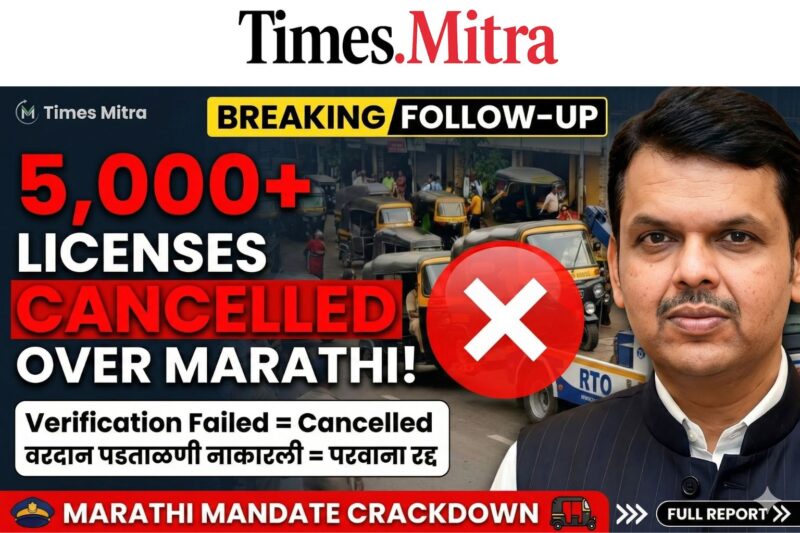
RTO Crackdown: Over 5,000 Licenses Revoked
The streets of Mira-Bhayandar are witnessing a seismic shift in transport regulation. In a bold and controversial move, the Regional Transport Office (RTO) has officially cancelled the licenses of more than 5,000 commercial drivers. The reason? A failure to meet the state’s mandatory Marathi language proficiency requirements.
This massive enforcement drive, framed under the banner of “Public Safety and Local Convenience,” has sent shockwaves through the auto-rickshaw and taxi unions of Mumbai’s satellite cities.
What began as a periodic verification process has escalated into a full-scale regulatory overhaul. According to the latest data released by the RTO, the proficiency tests were conducted with clinical precision, targeting a massive pool of drivers to ensure compliance with state-mandated communication standards.
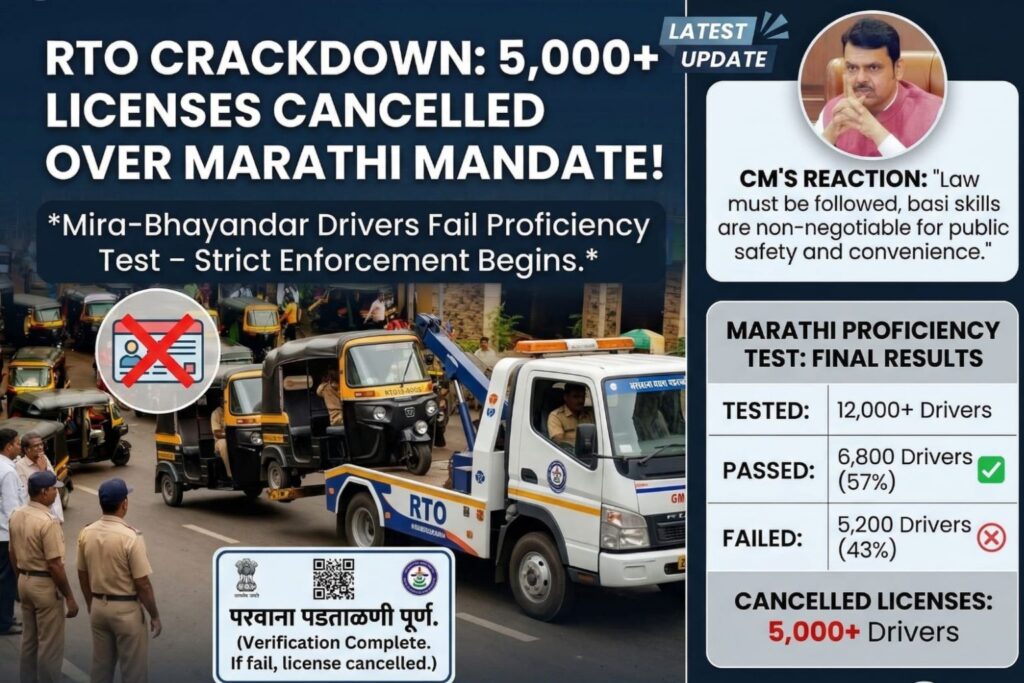
| Category | Statistics |
| Total Drivers Tested | 12,000+ |
| Passed (Proficient) | 6,800 (57%) |
| Failed (Non-Proficient) | 5,200 (43%) |
| Licenses Cancelled | 5,000+ |
The results highlight a significant gap in the workforce. While nearly 60% of the drivers successfully navigated the linguistic hurdles, a staggering 43% failed to meet the basic criteria required to hold a commercial permit in the region.
Why Language Proficiency Matters for Public Safety
While critics argue that driving ability should be the only metric for a license, the state government and RTO officials maintain a different stance. The core of the “Marathi Mandate” lies in the intersection of public service and safety.
A commercial driver is often the first point of contact for local citizens, many of whom may only be comfortable communicating in the state’s native tongue. In emergency situations, medical crises, or even standard navigation, the inability to understand or speak the local language can lead to severe misunderstandings, disputes, and safety hazards.
“Law must be followed. Basic skills are non-negotiable for public safety and convenience,” stated a senior government representative. “If a driver cannot communicate with the local populace they serve, it constitutes a failure in providing essential public service.”
Inside the Testing Centers: What Went Wrong?
The proficiency test wasn’t designed to be an academic linguistic exam. Instead, it focused on functional literacy—the ability to read road signs, understand local directions, and interact basic-level with passengers in Marathi.
Reports from the Mira-Bhayandar testing centers suggest that many drivers who have lived in the region for years struggled with reading official notifications and verbal communication. The “Verification Complete” stamp (परवाना पडताळणी पूर्ण) has become a symbol of job security for some and a career-ender for thousands of others.

Also Read: India’s New “Kamikaze Drones” Arrive: How a Surat Start-up is Changing Himalayan Warfare Forever!
The RTO has deployed towing vans and specialized squads to ensure that those with cancelled licenses are immediately taken off the road. The visual of auto-rickshaws being towed away has become a common sight, signaling that the era of “relaxed enforcement” is officially over.
Economic Fallout and the Road Ahead
The cancellation of 5,000 licenses is not just a regulatory statistic; it is an economic event. With over 5,000 drivers suddenly off the streets, the Mira-Bhayandar area is expected to face a temporary shortage of public transport options. Commuters may experience longer wait times and potential fare hikes as the supply of available rickshaws dwindles.
The Impact on the Driving Community:
- Loss of Livelihood: Thousands of families are now facing an uncertain financial future.
- Union Outcry: Several transport unions have labeled the move as “harsh,” calling for a grace period or bridge courses to help drivers learn the language rather than facing immediate cancellation.
- Stricter Barrier to Entry: Future applicants for commercial permits in Maharashtra will now view Marathi proficiency as a primary prerequisite, potentially shifting the demographic of the workforce.
A New Standard for Urban Governance?
This crackdown serves as a template for other regions in Maharashtra. By linking language proficiency to the legal right to operate a commercial vehicle, the government is reinforcing a “son of the soil” administrative approach while doubling down on the logic of regional administrative efficiency.
For the drivers who passed, it’s business as usual—albeit with a new sense of legitimacy. For the 5,000 whose licenses are now void, the road back to the driver’s seat will require more than just steering skills; it will require a mastery of the local tongue.
As strict enforcement begins, one thing is clear: the RTO is no longer just checking brakes and engines—they are checking the “basic skills” that define a public servant in the heart of Maharashtra.
Is this move a necessary step for public safety, or an unnecessary hurdle for the working class? Stay tuned to Times Mitra for more updates on the Mira-Bhayandar RTO crackdown.