

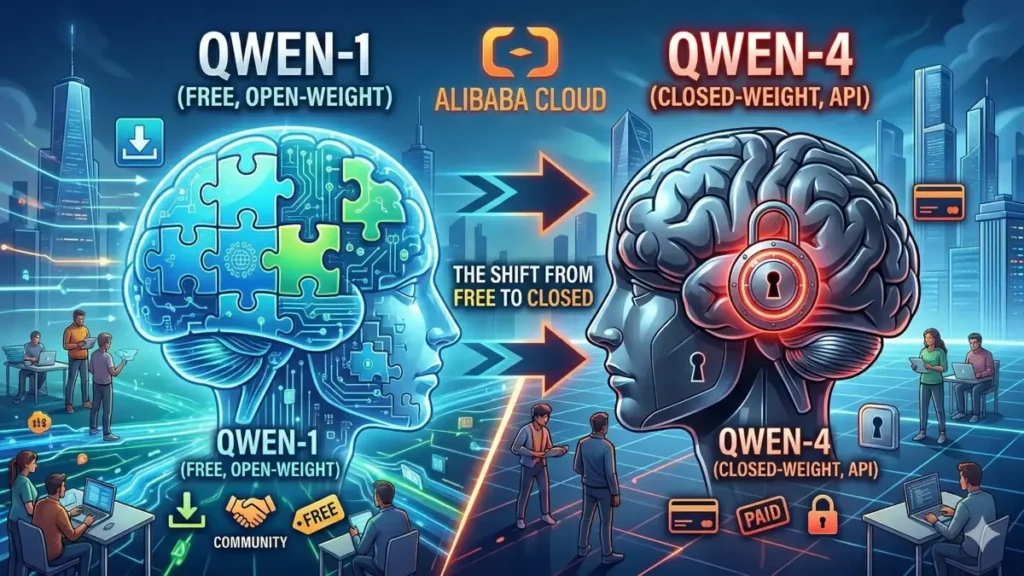
In a move that has sent shockwaves through the global AI community, Alibaba Cloud has reportedly begun pivoting its powerhouse Qwen AI (Tongyi Qianwen) from its famous “open-weights” strategy toward a more restricted, proprietary model. For a company that was once hailed as the “Meta of the East” for its commitment to open-source development, this shift marks a significant turning point in the AI arms race.
Also Read: Realme 16 5G Camera Review: 50MP Selfie Mirror vs. Pro 200MP
The End of an Open-Source Powerhouse?
Since its inception, Alibaba’s Qwen has been a darling of the open-source world. With over 113,000 derivative versions on platforms like Hugging Face and millions of downloads, Qwen provided developers with a high-quality alternative to closed models like GPT-4. However, the recent launch of flagship models like Qwen3.5-Omni and Qwen3.6-Plus tells a different story.
Unlike their predecessors, these latest iterations are largely “closed-source” or “API-only.” This means developers can no longer download the full model weights to run them locally for free; instead, they must pay to access them via Alibaba’s cloud infrastructure.
Why the Sudden Change? The Monetization Pressure
The primary driver behind this pivot is simple: The Cost of Innovation. Training massive LLMs (Large Language Models) requires billions of dollars in hardware and energy. Alibaba, like many tech giants, is facing immense pressure to turn its AI research into a profitable business.
By locking its most advanced models—especially those focused on high-value tasks like multimodal processing and coding agents—Alibaba is forcing enterprises to move away from free usage and into its paid ecosystem.
Also Read: Motorola’s Next Flagship Leaked: Massive 6,500mAh Battery and a Stunning Wood-Grain Design Revealed
Leadership Shakeup: A Sign of Internal Friction?
The timing of this pivot coincides with high-profile departures from the Qwen team. In early 2026, key figures including technical lead Junyang “Justin” Lin—the architect who grew Qwen into a global name—announced their exit. While Alibaba maintains that its “open-source strategy remains a priority,” the loss of its open-source champions suggests a deep-rooted shift in internal philosophy.
What This Means for Developers and Startups
For many startups that built their entire workflow on the assumption that Qwen would remain free and customizable, this is a “reckoning moment.”
- Rising Costs: Teams will now have to factor in API costs, which Alibaba recently hiked by up to 34% for certain cloud services.
- Limited Control: Without access to model weights, developers lose the ability to “fine-tune” models on their private data with total security.
- The Search for Alternatives: This move may push developers back toward Meta’s Llama or emerging rivals like DeepSeek, who are still doubling down on the open-source path.
A Hybrid Future?
Alibaba isn’t abandoning open source entirely—at least not yet. The company plans to continue releasing smaller, “distilled” versions of its models for the public. However, the “Flagship” models—the ones that actually compete with the likes of OpenAI’s GPT-o1 or Google’s Gemini—are now firmly behind a paywall.
The Closing Gate of AI
The “Golden Age” of free, top-tier open-weights models may be narrowing. Alibaba’s pivot proves that while open source is great for gaining market share and building a developer community, the ultimate goal for Big Tech remains a closed, controlled, and profitable garden.
For the latest tech and news updates stay connected to Times Mitra: https://times.motormitra.in/