
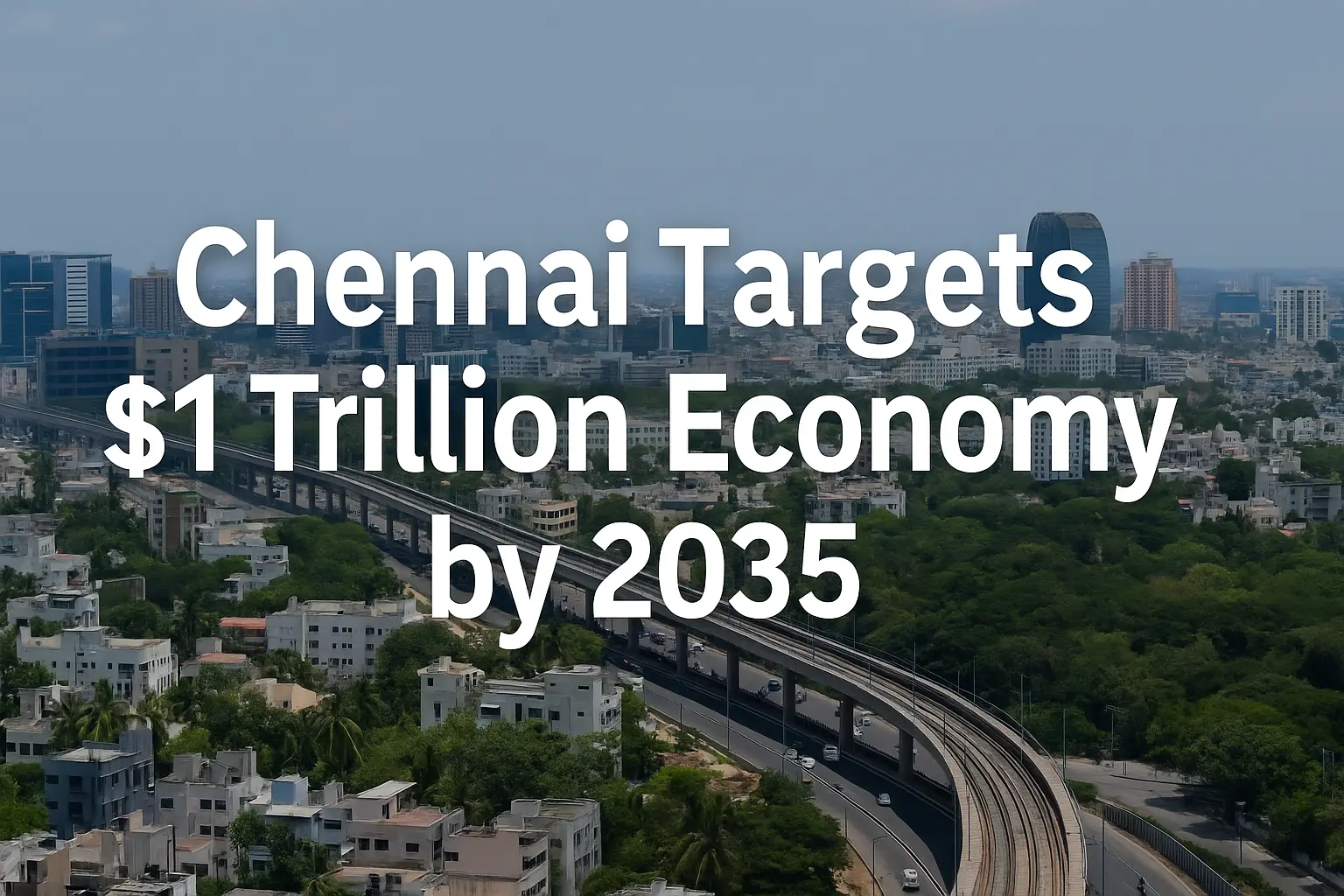
A New Vision for Chennai’s Economic Future
Chennai, once regarded primarily as the automobile and manufacturing capital of India, is undergoing a dramatic transformation.
The city is emerging as a high-technology industrial and innovation hub, aligning itself with Tamil Nadu’s ambitious vision of becoming a $1 trillion economy by 2035.
Driven by a powerful mix of industrial diversification, technology-driven manufacturing, and infrastructure expansion, Chennai is now positioning itself as one of Asia’s most dynamic urban economies.
Tamil Nadu, the state capitalized by Chennai’s rapid growth, recorded an economic expansion of 11.19% in FY 2024–2025, outpacing the national average of 6.5%.
This growth, underpinned by 14.7% growth in manufacturing, has made Tamil Nadu India’s most industrially advanced state and a model for economic resilience.
While the official target is 2035, analysts suggest Tamil Nadu could approach the $1 trillion milestone as early as 2032–2033, provided current momentum continues.

Also Read – India’s BRICS Chairmanship 2026: Shaping the Future
High-Tech Manufacturing Takes Center Stage
Chennai’s evolving economic identity reflects India’s broader industrial metamorphosis.
The city is now a nucleus for electronics, semiconductors, and precision engineering, attracting global corporations and technology innovators alike.
One of the most notable developments is KLA Corporation’s proposed ₹3,000 crore R&D center in Chennai, a move that could generate 3,000 high-skilled engineering and AI jobs.
The Nasdaq-listed semiconductor equipment giant, which reported $10.85 billion in global revenue in 2024, already operates research facilities in Chennai focused on software and algorithm development.
This initiative, in collaboration with the IIT Madras Research Park, underscores Chennai’s growing importance as a base for AI-driven and advanced computing industries.
The city’s industrial ascent is further cemented by its leadership in electronics manufacturing.
Tamil Nadu’s electronics exports reached $14.65 billion in FY 2024–25, representing a 53% year-on-year increase.
It is now home to over half of India’s Apple supply chain ecosystem, hosting manufacturing operations by Tata Electronics, Foxconn, and Pegatron.
According to industry leaders, Chennai’s diversity is its strength.
“Chennai will continue to be a heterogeneous industrial city,” said Suresh Sambandam, CEO of Kissflow.
“When one industry slows down, another sustains the city.”

Also Read – Bank of India SO Recruitment 2025 – 115 Vacancies Announced!
Infrastructure, Investment, and Innovation Drive Growth
The Tamil Nadu Global Investors Meet (GIM) 2024 marked a pivotal moment in the state’s economic journey.
The event secured investment commitments worth ₹6.64 lakh crore across 631 signed MoUs, targeting high-growth sectors such as electric mobility, data centers, renewable energy, and semiconductors.
Of these commitments, ₹59,454 crore has already been realized, with 13 projects entering commercial production.
This conversion ratio—nearly 9% within a year—demonstrates both government efficiency and investor confidence.
Simultaneously, Chennai’s startup ecosystem is expanding rapidly, supported by institutional innovation.
The IIT Madras Research Park is creating a ₹500 crore venture capital fund to support deep-tech and sustainability-focused startups, with the first close expected by March 2026.
The park has already incubated successful ventures such as Ather Energy and Uniphore, positioning Chennai as a cradle of next-generation entrepreneurship.
Electric Mobility and Industrial Modernization
Chennai’s commitment to electric vehicle (EV) infrastructure and clean manufacturing has added a new dimension to its growth narrative.
The city is witnessing the establishment of new EV charging networks by Relux Electric and GCC, with nine new charging stations set to go live before the end of 2025.
Manufacturing capacity is also scaling up.
Tivolt Electric Vehicles, one of Tamil Nadu’s emerging EV manufacturers, has inaugurated a 500,000-square-foot facility in Chennai, capable of producing 50,000 units annually.
The convergence of manufacturing, renewable energy, and logistics investments is gradually transforming Chennai into a fully integrated mobility hub, connecting supply chains from raw materials to advanced engineering.

Also Read – Asian Archery Championships 2025 – India Wins 3 Golds, 2 Silvers Medals
Income Growth and Urban Prosperity
Economists predict that Chennai’s rapid industrial and digital expansion will yield a fourfold increase in household incomes by 2035.
The city’s average household income, currently estimated at ₹2.5 lakh per year, is projected to rise to ₹10 lakh annually as high-skill employment and tech-driven enterprises dominate the economy.
“By 2035, Chennai will be a deeply integrated electronics and technology manufacturing hub,” Sambandam noted.
“It will stand alongside global industrial cities in productivity and innovation.”
This anticipated rise in income parallels improvements in urban infrastructure, public mobility, and education access, supported by Tamil Nadu’s aggressive push toward urban sustainability and digital governance.
Chennai’s Trillion-Dollar Trajectory
Chennai’s transformation is emblematic of India’s broader economic shift — from a traditional manufacturing economy to a technology-driven, innovation-led powerhouse.
Backed by policy reforms, global partnerships, and a thriving entrepreneurial culture, the city is well on its path to becoming a central pillar of India’s trillion-dollar ambitions.
With its unique combination of industrial heritage, academic excellence, and forward-looking governance, Chennai stands poised to redefine what a 21st-century Indian megacity can achieve.
Whether the target year is 2035 or 2033, one thing is certain — Chennai’s trajectory will serve as a blueprint for urban economic transformation across India.
Branding: Times Mitra | Economic Affairs Edition | November 2025
Thank you for reading. Don’t forget to subscribe for more coverage!