
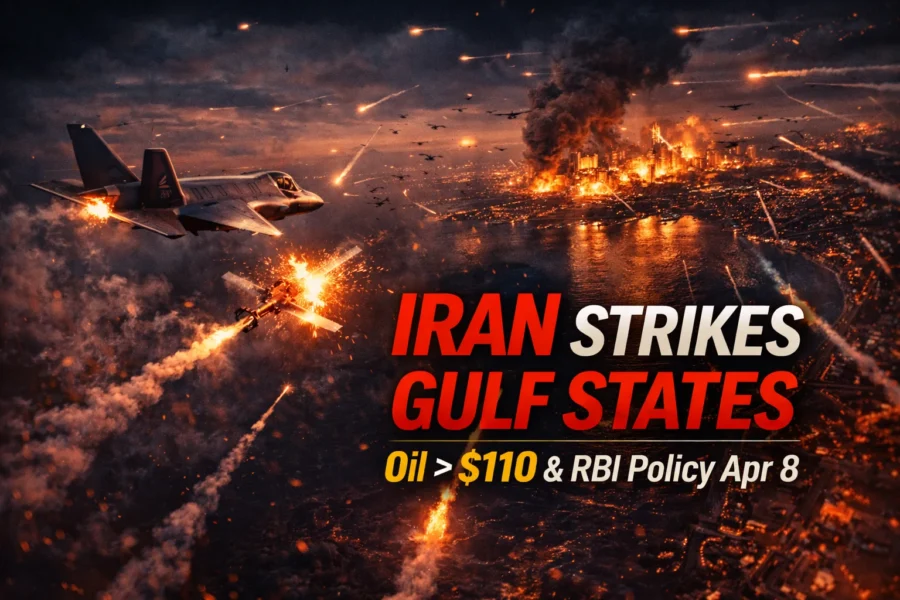
Iran has launched a fresh wave of missile and drone attacks against several Gulf states, marking another major escalation in a conflict that began in late February 2026. The strikes hit the United Arab Emirates, Kuwait, Qatar, Bahrain, and Saudi Arabia, turning the Persian Gulf into a front line for a war that many regional powers had hoped to avoid. Gulf air defenses worked through the night to intercept dozens of ballistic missiles and drones, while government officials warned that the attacks on energy and water infrastructure could have long‑term consequences for local economies and civilian life.
Scale of the latest barrages
The latest Iranian salvo came one day after U.S. President Donald Trump issued a 48‑hour ultimatum to Tehran, warning of intensified strikes if Tehran did not accept a ceasefire framework. In response, Iran launched a wide arc of missiles and drones across the Gulf, many of which were aimed at critical infrastructure rather than overt military bases.
The UAE’s Ministry of Defence reported on Sunday that its air defenses intercepted nine ballistic missiles, one cruise missile, and around 50 drones originating from Iran. Since the conflict began on February 28, the UAE has faced more than 470 ballistic‑missile attacks and over 2,000 drone assaults, with regional tracking data putting the total number of intercepted Iranian projectiles in the thousands.
Despite the heavy barrage, no new casualties were reported from this specific wave of strikes, although earlier rounds have already claimed lives and injured hundreds. The death toll in the UAE alone stands at a dozen fatalities and more than 200 wounded, with most injuries occurring in residential and industrial areas near intercepted missile debris.
Also Read: Iran Strikes Israel and Kuwait After Rejecting Trump Ultimatum: Global Economic Impact 2026
Damage to infrastructure in the UAE and Kuwait
In the UAE, the Borouge petrochemicals plant near Abu Dhabi suffered secondary damage from falling debris after air defenses shot down incoming missiles. Fires broke out in parts of the facility, prompting authorities to temporarily suspend operations while they assessed the structural and environmental impact. The nearby Habshan gas complex also dealt with debris from an earlier interception, causing a localized fire and a brief halt in operations.
The cumulative effect of repeated strikes has strained the country’s industrial and energy nodes, raising concerns about disruptions to petrochemical exports and domestic gas supply. Officials have assured the public that there was no direct hit on the main processing plants, but the repeated need to shut down units for safety checks has already begun affecting production schedules.
In Kuwait, the blows fell heavily on power‑generation and water‑desalination plants, which are critical in a country where most freshwater comes from desalination. The Ministry of Electricity, Water, and Renewable Energy confirmed that two generation units were taken offline, causing parts of the grid to rely more heavily on backup systems. The ministry described the damage as “significant material damage,” emphasizing that the facilities were civilian infrastructure and not military targets.
At the same time, fires were reported at Kuwait’s Shuwaikh and Mina Al Ahmadi oil facilities after drone strikes hit storage tanks and processing units. Emergency crews managed to contain the blazes without any reported casualties, but the repeated attacks on refineries and export terminals have raised red flags about the resilience of Kuwait’s energy sector.
Saudi Arabia, Qatar, and Bahrain under fire
Saudi Arabia’s air defenses intercepted seven ballistic missiles and about ten drones targeting the Riyadh metropolitan area in at least two separate waves. The Saudi military stressed that the incoming projectiles were tracked and destroyed before they could reach their intended targets, but debris from one intercepted missile fell in Al‑Kharj Governorate and caused injuries to two people.
The strikes underline the difficulty of defending a large, spread‑out capital region, even with advanced early‑warning systems and layered missile defenses. Civil defense units have increased patrols around critical sites, and the government has warned residents to stay alert for further alerts from the national emergency‑response network.

Also Read: Indian Markets Face Jittery Start: How Oil Prices and RBI Policy Can Move Your Portfolio
Qatar’s Ministry of Defence confirmed that the country was hit by a combination of drones and two cruise missiles, all of which were intercepted by its air defenses. The small Gulf state hosts one of the largest U.S. military bases in the region, Al Udeid Air Base, which has become a focal point in the broader Iran–U.S.–Israel confrontation. The Qatari government strongly condemned the attack, framing it as a violation of international law and a threat to regional stability.
In Bahrain, state oil company Bapco Energies reported a fire at an oil‑storage tank after an Iranian strike, describing the incident as part of a broader pattern of attacks on Gulf energy infrastructure. Bahrain has also absorbed several earlier waves of Iranian missiles and drones, forcing it to upgrade its radar and interceptor network in coordination with regional partners.
International military support and UK involvement
The United Kingdom has emerged as a key partner in the region’s air‑defense efforts, deploying Royal Air Force (RAF) Typhoon and F‑35B fighter jets to help Gulf states intercept Iranian drones and missiles. RAF F‑35Bs have already scored their first confirmed combat kills by shooting down Iranian‑designed drones over Jordan, marking the first time an RAF stealth fighter has destroyed a hostile aerial target in operations.
British forces have also activated Royal Navy assets, including Type 45 destroyers and Wildcat helicopters, to bolster missile and drone defenses in the Eastern Mediterranean and the northern Gulf. The UK government has explicitly stated that its role is defensive—supporting regional allies rather than launching offensive strikes—though it has warned Tehran that continued attacks on Gulf infrastructure could provoke a broader response.
Other Western and regional powers have stepped up military coordination as well, with the United States reinforcing its carrier‑strike groups and land‑based air‑defense batteries in Bahrain, Qatar, and the UAE. The heavy reliance on air defenses has turned the Gulf into one of the most densely protected airspaces in the world, with multiple countries sharing radar and tracking data in real time.
Regional political response and diplomatic efforts
The Gulf Cooperation Council (GCC)—which includes Saudi Arabia, the UAE, Kuwait, Qatar, Bahrain, and Oman—has issued a series of joint statements condemning the Iranian attacks as “aggression” against civilian infrastructure and a violation of international law. GCC foreign ministers have warned that the attacks could force them to consider a more coordinated and potentially more aggressive response, especially if Iranian strikes continue to target power plants, water facilities, and refineries.
Parallel to these warnings, back‑channel talks have been underway between regional and foreign powers, including Egypt, Turkey, Pakistan, and Saudi Arabia, aimed at opening a communication line with Tehran. These efforts have so far failed to produce a ceasefire, but they signal growing concern that an uncontrolled escalation could spiral into a wider regional conflict involving more countries.
Broader context: From US‑Israeli strike to full‑scale retaliation
This latest wave of attacks is part of a broader retaliatory campaign that Iran began after the United States and Israel launched surprise airstrikes inside Iran on February 28, 2026. Those strikes killed Supreme Leader Ali Khamenei and several senior officials, in what Tehran described as an unprecedented act of aggression. In response, Iran has fired hundreds of missiles and drones across the Persian Gulf, targeting US military installations, regional bases, and civilian infrastructure in the Gulf states.
Also Read: Don’t Buy an MG Yet — ₹3.5 Lakh Discounts Just Dropped on Windsor EV & Gloster
Iran’s military and state media have claimed that their main targets are American and Israeli military assets, but the pattern of strikes has increasingly focused on energy infrastructure, ports, and power‑generation sites. Analysts argue that this targeting reflects a strategy designed to inflict economic damage and pressure regional governments into pressuring the U.S. and Israel to de‑escalate.
At the same time, Iran has tightened its control over the Strait of Hormuz, restricting or delaying international shipping in a move that has further destabilized global energy markets. The ongoing clashes around one of the world’s most critical oil‑shipping chokepoints have raised fears of sustained supply disruptions and long‑term damage to Gulf economies.
Strategic and humanitarian implications
The recurrent missile and drone barrages have already begun to reshape the Gulf’s security architecture. Gulf states are investing heavily in additional air‑defense systems, more advanced radars, and greater integration with U.S. and European command networks. Economists and energy‑sector analysts warn that the accumulated damage to refineries, power plants, and desalination facilities could require billions of dollars in reconstruction and upgrades over the coming years.
For ordinary citizens, the psychological toll is growing. Many families in the UAE, Kuwait, Saudi Arabia, and Bahrain now live under the constant threat of alerts, sirens, and the possibility of another strike. Schools and businesses have adjusted routines, and governments have run civil‑protection drills to prepare populations for prolonged air‑defense operations.
In this volatile environment, the latest Iranian missile and drone attacks reinforce a grim reality: the Gulf states have become the unintended front line in a wider Iran–U.S.–Israel conflict. How the region responds—whether through more integrated defenses, deeper international partnerships, or renewed diplomacy—will shape the course of the war and the long‑term stability of the entire Persian Gulf.
For the latest tech and news updates stay connected to Times Mitra: https://times.motormitra.in/