
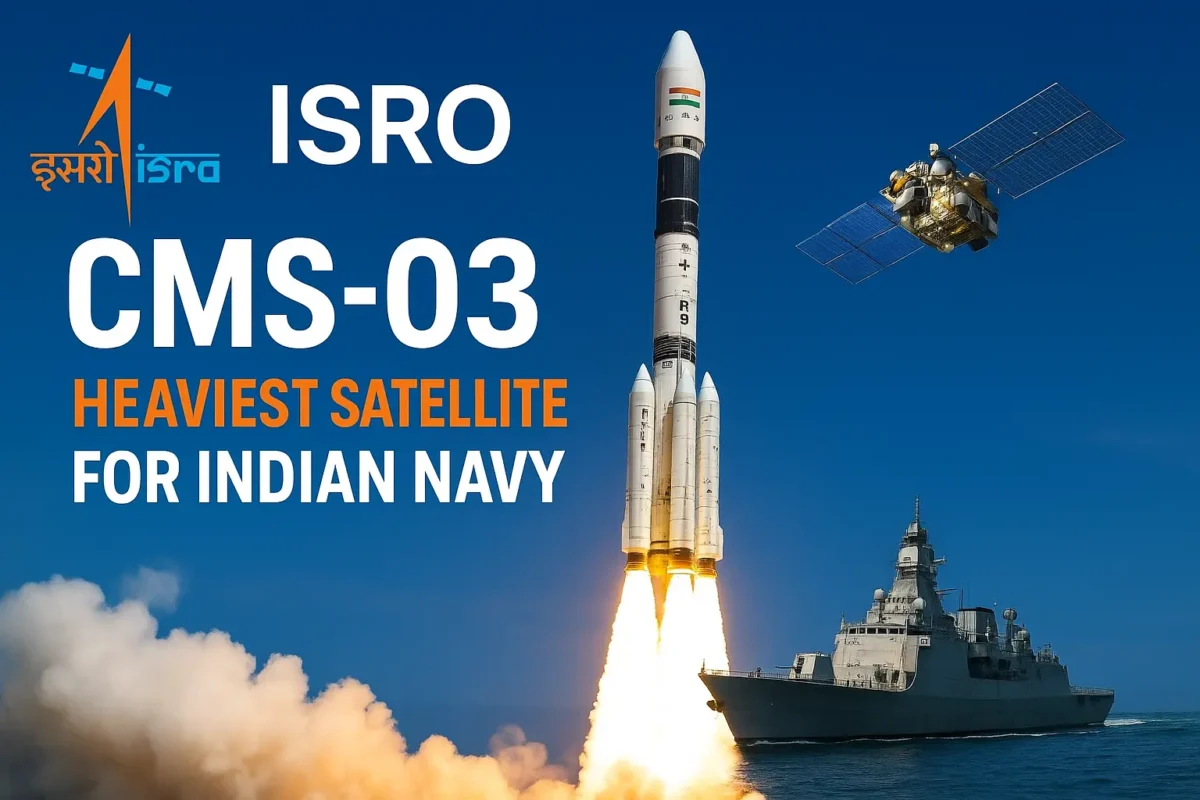
ISRO Launches Heaviest Satellite CMS-03 to Boost Naval Communications
Date: November 2, 2025
Location: Sriharikota, Andhra Pradesh
Mission: LVM3-M5 / CMS-03 Communication Satellite
The Indian Space Research Organisation (ISRO) has achieved yet another milestone with the successful launch of CMS-03, the heaviest communication satellite ever deployed from Indian soil. This mission marks a monumental step in India’s self-reliance in space technology, significantly boosting the Indian Navy’s communication and surveillance capabilities.
India’s Heaviest Communication Satellite
The CMS-03 satellite, weighing 4,410 kilograms, was launched aboard ISRO’s LVM3-M5 rocket (also known as “Bahubali”) from the Satish Dhawan Space Centre, Sriharikota. The launch took place at 5:26 PM IST, watched live across the nation by scientists, defense analysts, and citizens alike.
This mission not only showcases ISRO’s heavy-lift launch capabilities but also strengthens India’s position as a leading space power capable of deploying strategic satellites without relying on foreign launch services.
🔗 Official Mission Page: ISRO – LVM3-M5/CMS-03 Mission
LVM3-M5: India’s Mighty “Bahubali” Rocket
The LVM3 (Launch Vehicle Mark-3), India’s most powerful rocket, stands 43.5 meters tall and is capable of carrying 8,000 kg to Low Earth Orbit (LEO) and 4,000 kg to Geosynchronous Transfer Orbit (GTO).
The rocket’s three-stage propulsion system—solid, liquid, and cryogenic—ensures maximum efficiency and thrust, allowing the satellite to reach higher orbits with precision.
CMS-03 was placed into a transfer orbit of 170 km x 30,000 km, from which it will gradually maneuver into its final geostationary orbit.
🔗 Learn More: ISRO Official Website

Also Read – ISRO Moon Mission 2047: India’s Giant Leap
CMS-03: Revolutionizing Naval Communication
Designated as GSAT-7R, the CMS-03 satellite is specifically designed for the Indian Navy. It succeeds the GSAT-7 (launched in 2013) and greatly enhances India’s maritime domain awareness and secure communications.
Key Technical Highlights:
- Frequency Bands: UHF, S, C, Extended C, and Ku Bands
- Coverage: Up to 2,000 km from India’s coastline
- Functions: Voice, video, and data connectivity between ships, submarines, aircraft, and coastal bases
- Mission Life: Over 15 years
- Budget: ₹1,589 crore
This satellite forms the backbone of network-centric warfare for the Indian Navy, enabling secure real-time data sharing even in contested environments.
Indigenous Innovation & Self-Reliance
The CMS-03 mission is a testament to Atmanirbhar Bharat (Self-Reliant India) in high-end space technologies. Previously, heavy satellites exceeding 4,000 kg were launched through foreign agencies such as Arianespace.
Now, with LVM3 fully operational, India can independently deploy such satellites. The mission incorporated cutting-edge innovations including:
- Thermal management systems to withstand high radiation
- Advanced onboard propulsion for orbit raising
- Indigenous communication payloads for enhanced security
These developments align with India’s long-term space-defense roadmap under the Ministry of Defence.
Visit: Ministry of Defence – Official Site


🌊 Strengthening Maritime and National Security
CMS-03 is strategically crucial for maritime communication in the Indo-Pacific region. The satellite provides the Indian Navy with:
- Encrypted, high-bandwidth communication
- Real-time surveillance data transmission
- Interoperability with air and land-based systems
This capability reduces reliance on international systems such as Inmarsat, reinforcing India’s sovereign communication infrastructure and operational independence.
🔗 Learn More: DRDO – Space Technologies
Behind the Mission: ISRO’s Excellence
ISRO’s Chairman Dr. S. Somanath described the launch as “a defining moment in India’s journey towards complete autonomy in strategic communication technology.”
The mission follows months of rigorous testing and full-scale rehearsals after recent setbacks earlier in 2025, ensuring flawless performance across all three rocket stages.
🔗 Space Reforms & Private Participation: IN-SPACe Official Portal
From Space to Security: National Significance
The CMS-03 mission contributes not only to India’s defense preparedness but also to its geopolitical strength in the Indo-Pacific region. With growing maritime competition, India’s ability to maintain real-time surveillance and coordination through indigenous satellites is a major strategic advantage.
It also complements the PM Viksit Bharat Vision 2047, aiming for technological dominance across sectors including defense, space, and cyber systems.
🌠 Challenges & Future Outlook
While the mission was a success, the path was not easy. Launching such a massive satellite required addressing challenges like:
- Structural reinforcement for high payload mass
- Real-time orbital correction
- Managing cryogenic engine temperatures
- Integration of advanced telemetry systems
The success of LVM3-M5/CMS-03 now opens the door for future missions such as:
- GSAT-20 (Next-Gen Broadband Satellite)
- Gaganyaan (India’s first crewed mission)
- Deep Space Exploration beyond lunar orbit

Conclusion: A Leap for India’s Space & Defense
The launch of CMS-03 marks a defining moment in India’s space and defense synergy. It not only enhances naval communication infrastructure but also symbolizes India’s readiness to compete globally in advanced satellite engineering.
With this mission, India moves one step closer to realizing self-reliant defense space capabilities, laying the foundation for a stronger, more secure, and connected nation.
For more updates on government schemes, jobs, and reforms, stay tuned to times.motormitra.in.

