
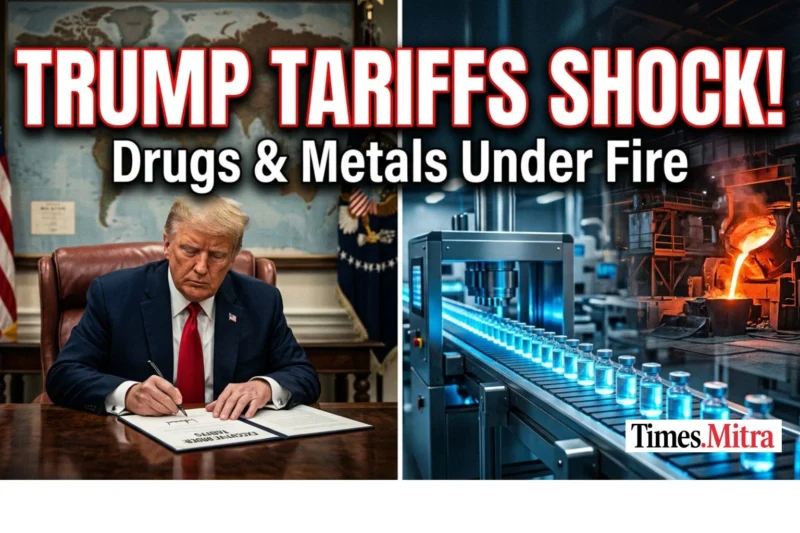
On the first anniversary of his “Liberation Day” trade offensive, U.S. President Donald Trump has signed two sweeping executive orders that sharply raise tariffs on imported pharmaceuticals and overhaul existing duties on steel, aluminium and copper. The moves, announced on “Liberation Day 2.0,” mark a further escalation of the president’s aggressive tariff‑driven strategy to force multinational companies to shift manufacturing back to the United States and reshape global supply chains around Washington’s industrial priorities.
New pharmaceutical tariffs: up to 100%
The first order targets the pharmaceutical sector and introduces a tiered tariff structure based on whether drugmakers agree to lower prices and establish domestic production. Under the new framework, companies that have not committed to both pricing concessions under a “most favoured nation” model and the construction of new U.S. factories will face a 100 per cent tariff on patented drug imports.
Large drugmakers will have a 120‑day grace period before the full 100 per cent rate kicks in, while smaller firms are being given 180 days to comply. The administration has set a deadline of 31 July for the tariffs to begin, after which companies that fail to meet the conditions will see their finished products effectively doubled in cost at the border.
To create an incentive for domestic investment, firms that pledge to build new U.S. plants—conditions specify that those facilities must be completed by the end of Trump’s second term—will instead pay a reduced 20 per cent rate. That lower rate will only be temporary, however; the order stipulates that the tariff for these companies will rise back to 100 per cent by April 2030 if they do not meet their production commitments.
Generics and biosimilars are currently exempt from the new pharmaceutical tariffs, a carve‑out that the White House says is intended to protect affordable medicines. At the same time, senior officials have indicated that the Commerce Department will review the status of generic manufacturers if they do not also move toward domestic production in the coming years.
Several allied trading partners have been granted preferential treatment. The European Union, Japan, South Korea and Switzerland will face a 15 per cent pharmaceutical tariff on patented drugs, while the United Kingdom has secured a 10 per cent rate through its existing trade arrangements with the U.S.
A senior administration official told reporters that the administration expects “the lion’s share of the world’s patented pharmaceuticals to be building in America” within the next decade, a goal that would profoundly reshape the global drugs supply chain and potentially raise the cost of many branded medicines for consumers outside the United States.
Metals overhaul: shifting the tariff base
The second proclamation, scheduled to take effect the following Monday, restructures Section 232 tariffs on steel, aluminium and copper. The core change is that the 50 per cent duty on raw metals will now be calculated on the price that U.S. buyers actually pay, rather than on the declared export value reported by foreign producers.
Administration officials argue that this adjustment will make it harder for foreign exporters to artificially deflate their reported prices and thus evade the full impact of the tariffs. By tying the levy to the transaction price seen in the U.S. market, the government says it is closing a loophole that had allowed some exporters to ship low‑margin, high‑volume material into the country.
For derivative products—such as machinery, vehicles, or construction components that contain substantial amounts of steel, aluminium or copper—the White House factsheet introduces a flat 25 per cent tariff on the full value of those goods. This effectively broadens the reach of the Section 232 regime beyond raw ingots and bars into finished or semi‑finished industrial goods.
Perhaps the most significant carve‑out is for products that contain relatively small amounts of metal. Any item containing 15 per cent or less metal by weight will no longer be subject to Section 232 tariffs at all, a move that is expected to ease the burden on many consumer goods and electronics manufacturers that rely on these metals but do not consider them core components of their products.
Framing the impact on consumers
In public statements, the administration has insisted that the latest measures will not noticeably raise prices for ordinary consumers. “These will not have impact on the price of the good on the shelf,” one senior official told Bloomberg, echoing the White House’s long‑standing claim that tariffs are paid by foreign producers rather than by American households.
Economists remain divided on that assertion, with many pointing out that importers often pass higher duties on to buyers through markups or reduced competition. The 100 per cent pharmaceutical tariff in particular raises the prospect of higher prices for insured and uninsured patients, especially if branded drugmakers choose to absorb only part of the cost increase and retain pricing power.
On the metals side, downstream manufacturers that rely heavily on steel, aluminium and copper—such as automakers, appliance makers, and construction firms—may face tighter margins unless they can renegotiate contracts with suppliers or shift to alternative materials. The 25 per cent flat tariff on derivative products could also complicate global supply chains, encouraging companies to conduct more processing within the United States to avoid the new levy.
Trade tensions and “Liberation Day”
Trump’s latest tariff barrage is framed domestically as the second‑year follow‑through of his “Liberation Day” agenda, which began on 2 April 2025 when he imposed broad import levies on nearly every U.S. trading partner. That first‑wave of tariffs, justified on national‑security and industrial‑policy grounds, triggered retaliatory measures from the European Union, China and several Asian economies and led to a sharp rise in global trade tensions.
This year, the administration is portraying the pharmaceutical and metals changes as a refinement rather than a new escalation, emphasizing streamlined rules and the 15 per cent threshold exemption for low‑metal goods. Yet from the perspective of many U.S. allies and trading partners, the move feels like a deepening of the president’s confrontational stance, particularly in the highly sensitive pharmaceutical sector.
European governments have already signaled that they may view the new pharmaceutical tariffs as a breach of spirit, if not of letter, of existing trade agreements, especially given the 100 per cent rate that would apply to companies that do not commit to U.S. manufacturing. Japanese and Korean officials have likewise warned that the changes could disrupt established supply chains for high‑tech and medical industries.
Industrial policy and long‑term stakes
At its core, the new package represents a bold bet on industrial policy: that high tariffs, combined with clear deadlines and incentives, can force global pharmaceutical and metal producers to relocate their factories to the United States. The administration argues that this would not only boost domestic employment but also strengthen national‑security‑critical supply chains, from medicines to defence‑related materials.
Critics, however, warn that the approach risks undermining long‑term innovation. Drugmakers may choose to scale back R&D or reduce investment in certain disease areas if large‑scale tariff threats make long‑term planning more uncertain. Similarly, metal producers and fabricators could respond by shifting production to tariff‑free jurisdictions or by imposing stricter terms on U.S. customers, rather than simply shifting capacity to American soil.

Also Read: Big Surprise! New-Gen Kia Seltos Hybrid Debuts with AWD & 1.6L Engine: What India Will Get in 2027
For India, the European Union, and many developing‑country drug exporters, the 100 per cent pharmaceutical tariff creates a difficult choice: either accept the cost of higher export duties and risk losing U.S. market share, or invest heavily in new U.S. plants that may not be economically viable in the long run if tariffs are later relaxed or if trade relations deteri
As “Liberation Day 2.0” rolls out, Trump’s latest tariff orders underscore a simple reality: tariffs have become the central tool of U.S. trade policy. The combination of punitive duties on patented drugs and the restructuring of Section 232 metals levies signals a more interventionist approach in which the government seeks to steer not just trade flows but also corporate investment decisions worldwide.
Whether this strategy will succeed in bringing large volumes of pharmaceutical and metal manufacturing back to the United States—or simply raise prices, provoke retaliation, and destabilize global supply chains—remains to be seen. One thing is clear: the anniversary of “Liberation Day” has added a new and far‑reaching chapter to the global debate over the role of tariffs in 21st‑century economic policy.
For the latest tech and news updates stay connected to Times Mitra: https://times.motormitra.in/