
By Times Mitra | March 31, 2026
The ongoing confrontation between Iran and the United States has entered a more volatile and unpredictable phase, with fresh incidents across the Gulf region raising fears of a wider conflict. Explosions reported in Dubai, a major oil tanker attack near the UAE coast, and sharp movements in global oil prices underline how rapidly the situation is escalating beyond conventional military targets.


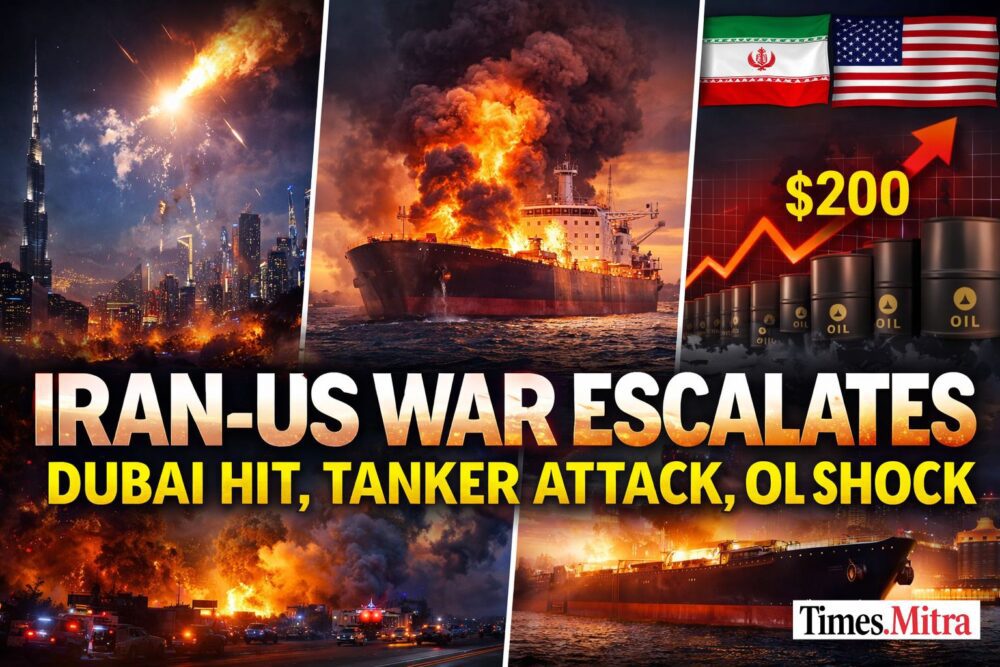
Authorities in the United Arab Emirates confirmed that emergency protocols were activated following a missile-related threat over Dubai. Interceptions reportedly took place mid-air, but falling debris triggered fires in parts of the city. Residents were advised to remain indoors as emergency services moved quickly to contain the situation. While the full extent of damage remains under assessment, early reports suggest that injuries were limited, preventing a larger humanitarian crisis in one of the region’s busiest urban centers.
Also Read: Modi’s Big Tech Push — Chip Manufacturing Starts in Gujarat, EV Sector to Benefit
The incident signals a critical shift in the conflict’s geography. What was previously concentrated around military installations and strategic zones is now increasingly spilling into civilian and commercial hubs, heightening risks for both residents and international businesses operating in the Gulf.


In a parallel development, a Kuwaiti oil tanker was struck near Dubai, sparking a fire onboard and raising immediate concerns about a potential environmental disaster. The vessel, reportedly carrying a large volume of crude oil, sustained damage following what is believed to be a drone or missile strike. Emergency response teams were able to control the blaze, and all crew members were reported safe, but the incident has intensified concerns about maritime security in the region.
The attack on an oil tanker underscores a broader strategic pattern. Energy infrastructure and shipping routes have increasingly become targets, reflecting an attempt to disrupt global supply chains and exert economic pressure. The Gulf region, particularly the Strait of Hormuz, remains one of the most critical chokepoints for global oil transit, handling a significant share of the world’s crude exports.
As tensions rise, global oil markets are reacting sharply. Prices have surged amid fears of prolonged supply disruptions, with analysts warning that sustained escalation could push crude prices to unprecedented levels. The uncertainty has already triggered volatility across financial markets, with energy-dependent economies closely monitoring developments in the Gulf.

The economic ripple effects are being felt worldwide. Higher oil prices translate directly into increased fuel costs, inflationary pressure, and disruptions across industries reliant on stable energy supply. Shipping companies have begun reassessing routes, while insurers are raising premiums for vessels operating in high-risk zones.
At the center of these developments is the growing strategic importance of key locations such as the Strait of Hormuz and Iran’s Kharg Island, a major oil export terminal. Any disruption or direct military action in these areas could significantly alter global energy flows. There are increasing indications that both sides are evaluating high-impact options, which could further intensify the conflict.
The broader military context adds another layer of complexity. The United States has expanded its operational footprint in the region, targeting multiple sites linked to Iran’s defence and nuclear infrastructure. In response, Iran has demonstrated its capability to strike not only military targets but also economic assets, including shipping and energy infrastructure across the Gulf.
This evolving strategy reflects a shift toward hybrid warfare, where economic disruption and psychological impact are as critical as battlefield gains. Attacks on high-visibility targets such as major cities and oil tankers send a strong signal to global markets and political stakeholders, amplifying the overall impact of each incident.
Also Read: RR Favoured in CSK Clash Toss Call as Trends, Stats Align (IPL 2026)
Diplomatic efforts, meanwhile, appear limited. Despite growing international concern, there has been little indication of immediate de-escalation. Regional powers remain on high alert, and global institutions are closely monitoring the situation, recognizing the potential for a broader conflict that could draw in multiple countries.
For countries like India and others heavily dependent on Gulf energy supplies, the stakes are particularly high. Any prolonged disruption in oil flow could affect domestic fuel prices, trade balances, and economic stability. Governments are likely to explore contingency plans, including diversifying supply sources and strengthening strategic reserves.
The latest developments — from explosions in Dubai to attacks on critical oil infrastructure — mark a turning point in the Iran–US conflict. What began as targeted military engagement is now evolving into a wider geopolitical and economic crisis, with consequences that extend far beyond the Middle East.
For the latest tech and news updates stay connected to Times Mitra: https://times.motormitra.in/