
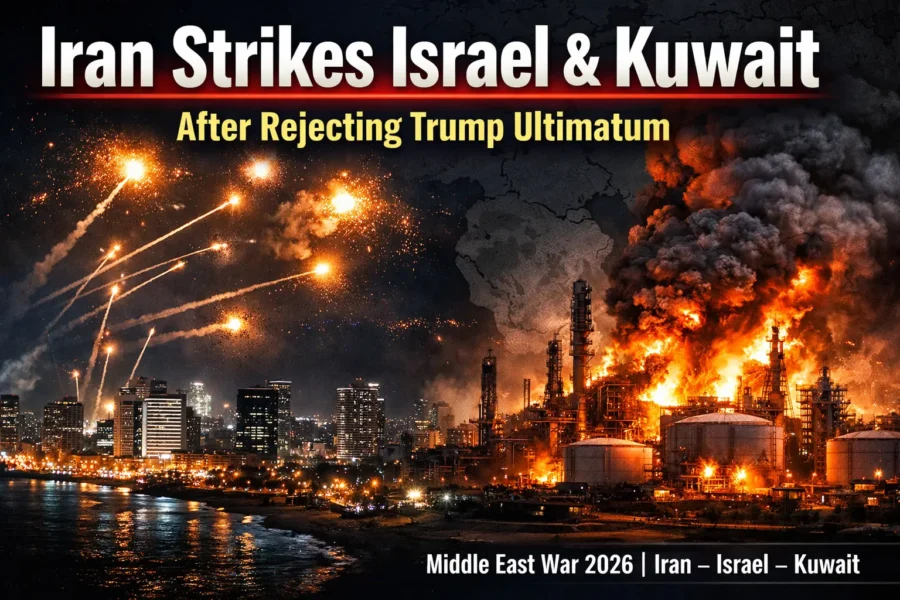
Tehran has launched fresh waves of missiles and drones at Israel and Kuwait just hours after rejecting a 48‑hour ultimatum from US President Donald Trump to reopen the Strait of Hormuz or strike a peace deal. The coordinated attacks mark a sharp escalation on the 37th day of the wider Middle East conflict, which began when Washington and Tel Aviv launched joint strikes on Iran following the collapse of nuclear‑talks negotiations.
Trump’s “48‑Hour Hell” Threat
On Saturday, Trump issued a stark warning on his social platform Truth Social: “Time is running out — 48 hours before all Hell will reign down on them. Glory be to GOD!” The message referred to a 10‑day pause he had announced on 26 March, during which the US promised to avoid targeting Iranian energy infrastructure if Tehran eased its blockade of the Strait of Hormuz. His self‑imposed deadline expires on Monday, 6 April, at 8 p.m. Eastern Time.
Iran’s military leadership dismissed the threat as a sign of desperation. General Ali Abdollahi Aliabadi, speaking from the Khatam al‑Anbiya Central Headquarters, branded Trump’s warning “a helpless, nervous, unbalanced and stupid action.” He added that “the simple meaning of this message is that the gates of hell will open for you,” implying that any further escalation would trigger a broader regional war.

Missiles and Drones Hit Tel Aviv and Kuwait
According to the Israeli military, seven waves of Iranian missiles have struck Israel since midnight on Saturday. Missile fragments landed in a car park near the Kirya military base in Tel Aviv, the IDF’s headquarters, causing damage but only limited casualties. Cluster munitions and shrapnel also hit neighborhoods in Tel Aviv, Bnei Brak, Petah Tikva, and Ramat Gan, with Israeli emergency service Magen David Adom reporting five minor injuries.
In the Gulf, Iran’s drones targeted the Mina al‑Ahmadi oil refinery in Kuwait on Friday, sparking large fires across the facility. A nearby desalination plant was also hit, though the full extent of damage remains under assessment. Kuwait’s state news agency KUNA confirmed “hostile missile and drone strikes” across the country, with air‑raid sirens and explosions heard from dawn into the late afternoon. The United Arab Emirates said it had intercepted 19 ballistic missiles and 26 drones on Thursday alone, underscoring how tightly the region is on edge.
Oil Markets Under Siege as Hormuz Stays Closed
The wider conflict has effectively blocked roughly 20 percent of global oil flows through the Strait of Hormuz, a narrow chokepoint linking Persian Gulf producers to global markets. Oil prices have surged past $110 per barrel for Brent crude, with analysts warning of even sharper increases in the coming weeks.
The International Energy Agency has cautioned that April could see conditions worse than March, when Brent rose to levels not seen since the 1980s‑era oil shocks. Crude‑price spikes are already feeding through into higher diesel and gasoline costs, especially in Europe and parts of Asia, where seaborne imports are heavily dependent on Gulf supply.
Diplomatic Efforts in the Shadow of Deadlines
Despite the missile exchanges and furious rhetoric, diplomatic channels remain open. Mediators from Pakistan, Türkiye, and Egypt are quietly shuttling between Washington, Tel Aviv, and Tehran in an effort to broker face‑to‑face talks. Multiple officials say both sides are using the 48‑hour window as a bargaining chip rather than a hard cutoff, but the risk of a miscalculation is growing.
As the Monday deadline approaches, markets, militaries, and civilians across the region are bracing for one of three possible outcomes: a last‑minute ceasefire, a limited escalation inside Iran’s borders, or a full‑scale regional war that could redraw the map of Middle East power—and the global energy order.

Global economic impacts of Strait of Hormuz blockade
A prolonged blockade of the Strait of Hormuz would trigger major shocks across the global economy, touching energy markets, inflation, trade, and financial stability.
1. Sharp rise in oil and energy prices
The Strait of Hormuz carries about 20% of global seaborne oil shipments, so even a partial or temporary closure can instantly tighten global supply. Models suggest that if the chokepoint remains blocked for weeks, Brent crude prices could quickly push past 100–130 dollars per barrel, driving up gasoline, diesel, and jet‑fuel costs worldwide.
These higher prices feed directly into transport, power generation, and manufacturing, because almost every industry depends on energy‑intensive inputs such as electricity, chemicals, and plastics.
2. Global inflation and stagflation risk
Higher fuel and input costs tend to spread through the economy, raising prices for air travel, shipping, food, and basic manufactured goods. Studies estimate that a medium‑ to long‑term blockade could push global inflation up by 1–2.5 percentage points, depending on duration.
If growth slows at the same time—because high energy costs hurt consumers and businesses—world‑wide economies could face stagflation: rising prices with weak output, similar to the 1970s‑era oil shocks.
3. Supply‑chain disruptions and trade losses
The Gulf states (Iran, UAE, Qatar, Kuwait, Bahrain) ship around 1.2 trillion dollars’ worth of trade annually through the Strait. A sustained blockade would force rerouting or delays, disrupting everything from oil and LNG to chemicals and manufactured goods.
Shipping companies may push back schedules, raise freight rates, or avoid the region altogether, driving up insurance premiums and logistics costs and slowing delivery of both energy and industrial inputs.
4. Growth hit and GDP losses
Economic simulations for the current Iran–US–Israel conflict show that even a short‑term blockade (under two weeks) could cost the world economy around 330 billion dollars in lost GDP. If the Strait stays closed for 3–6 months, potential losses balloon to roughly 2.2 trillion dollars, with some Gulf economies shrinking by over 20%.
Emerging‑market and energy‑importing countries tend to suffer most, as they face higher import bills, currency depreciation, and pressure on central‑bank interest‑rate policies.
5. Sovereign‑debt and fiscal strains
Oil‑exporting Gulf states lose hundreds of millions of dollars in daily oil and gas revenue despite higher prices, because volumes cannot be shipped. At the same time, energy‑importing nations face bigger subsidy bills and widening trade deficits, straining budgets and debt‑servicing capacity.
Credit‑rating agencies may reassess sovereign risk for countries overly exposed to either oil exports or refined‑fuel imports, which can raise borrowing costs and complicate crisis‑funding.
6. Long‑term shifts in energy and trade patterns
Beyond the immediate shock, a serious closure could accelerate efforts to diversify away from Gulf oil and gas, including more investment in renewables, nuclear, and alternative trade corridors. Governments may also push for strategic stockpiles, regional refining capacity, and stronger energy‑security partnerships, reshaping investment and policy priorities for years.
In short, a sustained Strait of Hormuz blockade would not just raise pump prices—it would re‑order global trade, test fiscal stability, and force a structural rethink of how the world supplies and consumes energy.
For the latest tech and news updates stay connected to Times Mitra: https://times.motormitra.in/