
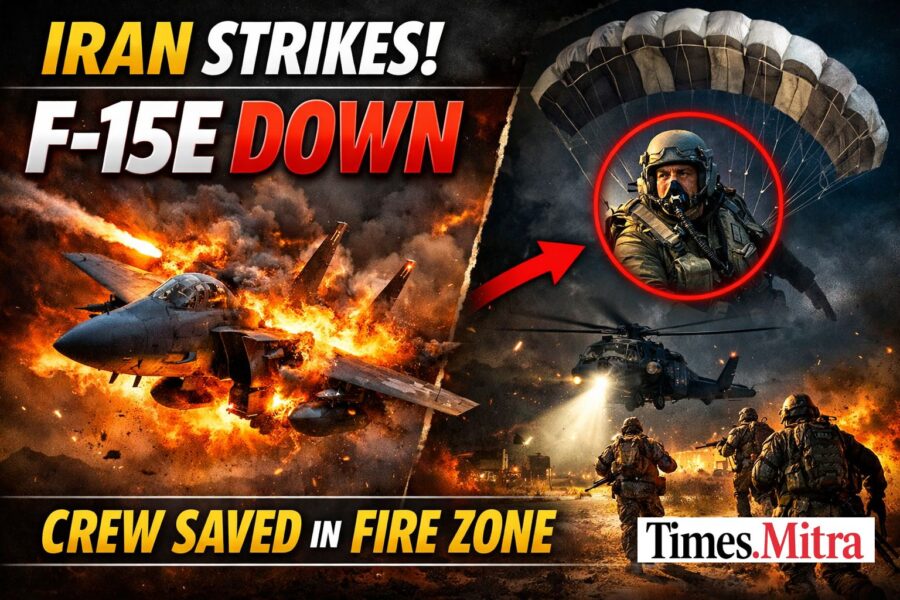
U.S. F‑15E Crew Fully Rescued After Iran Shootdown in High‑Stakes Operation
The downing of an American F‑15E Strike Eagle over Iran on April 3, 2026, and the subsequent recovery of both crew members has become one of the most dramatic chapters of the early‑phase U.S.–Iran war, known inside the Pentagon as Operation Epic Fury. The incident not only exposed the lethal reach of Iran’s air defenses but also showcased the responsiveness and risk tolerance of U.S. special operations in a high‑threat environment just weeks into open conflict.
On a Friday afternoon, an F‑15E Strike Eagle, operating as part of a strike package targeting Iranian military infrastructure, was hit by enemy fire over southwestern Iran. U.S. officials confirmed that the aircraft belonged to the 494th Fighter Squadron, a unit normally deployed from a forward base in the Middle East. The two‑man crew ejected and parachuted into rugged terrain, with the pilot and weapons systems officer (WSO) separating after landing.
Also Read: TRAI vs Jio: “End Discriminatory Tariffs by April 14” – What It Means for Your Recharge Wallet
Iran’s Islamic Revolutionary Guard Corps (IRGC) quickly claimed responsibility for the shootdown, portraying it as a major success in what Tehran framed as a defensive campaign against foreign aggression. The loss marked the first time a manned U.S. warplane had been shot down by confirmed enemy fire since the outbreak of the broader Iran conflict at the end of February 2026, and one of at least seven American aircraft lost in little over a month of combat.
Within hours of the shootdown, U.S. Central Command launched a combat search and rescue (CSAR) operation. Two HH‑60 Pave Hawk helicopters, supported by an HC‑130 refueling and command aircraft, pushed into Iranian airspace to locate the downed airmen. The mission was further complicated by the presence of Iranian forces and local militia units that had begun combing the crash zone after the IRGC broadcast an appeal asking civilians to find the crew and turn them in for a reward equivalent to roughly 10 billion Iranian Toman (about 60,000 U.S. dollars).

Also Read: Iran Strikes Israel and Kuwait After Rejecting Trump Ultimatum: Global Economic Impact 2026
The first crew member, the pilot, was located relatively quickly and hoisted aboard one of the HH‑60s. But as the rescue helicopters began to exit hostile airspace, Iranian small‑arm and likely anti‑aircraft fire opened up on the formation. One Pave Hawk sustained hits, wounding several crew members on board, though it managed to land safely at a nearby allied base. An A‑10 Thunderbolt II, providing close‑air support to the CSAR package, was also struck by Iranian fire. The A‑10 pilot flew the damaged aircraft out of Iranian airspace before ejecting over the Persian Gulf, where he was recovered and brought back to safety.
The intensity of that initial attempt underscored how quickly what should have been a standard rescue mission had turned into a costly, multi‑aircraft engagement. By the end of the day, four different U.S. aircraft had taken hostile fire, a level of attrition that raised concerns inside the Pentagon about the durability of sustained air operations over Iran.
Even as the first crew member was brought back to U.S. control, the second, the weapons systems officer, remained on the ground deep inside southwestern Iran. For roughly 48 hours, the status of that airman was officially listed as “missing in action,” with U.S. officials privately admitting that they did not know his exact location. Iranian state media continued to run appeals, emphasizing that any captured U.S. pilot would be treated harshly and exhibited as a captured “enemy combatant.”
The WSO, however, maintained contact with U.S. forces using encrypted survival radios and tightly coordinated evasion procedures learned at the military’s survival, evasion, resistance and escape (SERE) schools. Intelligence reports indicated that he moved through mountainous terrain in Chaharmahal and Bakhtiari Province, avoiding main roads and populated areas while transmitting periodic updates on his position and health.

Also Read: Strong Earthquake Tremors Felt in Delhi-NCR: Magnitude 5.9 Hits Hindu Kush, Afghanistan
Israel, which had been conducting its own covert strikes against Iranian targets, paused planned operations for a window to avoid disrupting the U.S. search effort and to prevent any friendly‑fire or coordination problems over Iranian airspace. Regional allies quietly provided intelligence and surveillance support, including satellite imagery and signals‑intelligence data, to help U.S. planners narrow the search area while ensuring that Iranian forces could not shadow the missing airman’s every move.
By the early hours of April 5, U.S. planners had enough tracking data and situational awareness to launch a second, even more dangerous rescue attempt. This time the operation shifted from a conventional CSAR to a short‑duration commando raid inside Iranian territory. Social‑media posts from military analysts and veterans, including Jack Murphy, a former Green Beret and prominent conflict journalist, described the mission as involving elite U.S. Army Special Forces and likely Delta Force elements, inserted either by low‑level rotary‑wing infiltration or via fast‑rope and rappel techniques into a remote valley.
The rescue team reportedly linked up with the WSO in the pre‑dawn darkness, taking Iranian security forces and local militia by surprise. A brief but intense firefight erupted at the site, as Iranian units attempted to intercept the American force. Video clips circulating on social media appeared to show tracer fire and explosions in mountainous terrain consistent with the region around Chaharmahal and Bakhtiari, though none of the footage was officially confirmed by U.S. authorities.
Also Read: Top 10 Cars March 2026: Dzire to Scorpio – Buyers Are Making This Big Mistake
Despite the engagement, all U.S. personnel involved in the operation are believed to have exited Iranian airspace safely, with the recovered WSO in U.S. hands by dawn local time. A U.S. official told Air & Space Forces Magazine that the aviator was alive and in good condition, and that all American forces participating in the mission had returned without additional casualties. The successful extraction concluded more than 48 hours of nervous waiting in Washington and among the families of the downed airmen, and was immediately hailed as a textbook example of long‑range, high‑risk combat rescue under wartime conditions.
The entire incident has major implications for how the U.S. conducts air operations over Iran for the remainder of Operation Epic Fury. The fact that Iran managed to shoot down an F‑15E—among the most capable multi‑role strike fighters in the U.S. Air Force inventory—demonstrates that Tehran still possesses a functional, layered air‑defense network built on decades of investment. Analysts have pointed out that the loss of at least seven American aircraft since early March 2026 suggests that attrition, electronic warfare, and surface‑to‑air missile threats are larger hurdles than previously assumed.
At the same time, the successful recovery of both crew members signals something equally important to adversaries and allies alike: the U.S. remains willing to send high‑risk missions deep into enemy territory to retrieve its personnel. In the modern age, where public perception can swing as quickly as breaking news reports, the image of a downed American pilot being rescued from captivity can be as important as the tactical outcome of any single strike.
The Iranian regime, for its part, has tried to downplay the failure of its forces to capture either airman, instead emphasizing that the shootdown itself was a victory. But the fact that both U.S. aviators were recovered alive, and that Iranian forces were reportedly pushed back in a firefight with American special operators, feeds a narrative of technological and operational superiority that the Pentagon has been keen to project.
Beyond the hardware and strategy, the episode underscores the human toll of the conflict. The downed F‑15E crew members are now part of a grim statistic: more than a dozen U.S. service members have been killed in action since the start of the Iran war, with hundreds wounded and several others wounded or missing over the first five weeks. The psychological strain on aviators flying missions over Iran, knowing that a single hit can trigger a long, perilous evasion and rescue saga, is likely substantial.
For the rescued crew members, the next phase will involve medical evaluations, debriefings, and a period of recovery before any discussion of returning to flight status. The U.S. Air Force may also launch a formal investigation into the circumstances of the shootdown, including questions about tactics, fuel margins, electronic‑warfare support, and whether the F‑15E was operating inside a more heavily defended corridor than originally planned.
The rescue of the second F‑15E crew member changes the immediate narrative of the Iran conflict, but it does not alter the underlying reality that the U.S. and its allies are engaged in a high‑stakes, high‑risk campaign against a well‑prepared adversary. Future operations may see even heavier reliance on drones, standoff missiles, and electronic warfare to limit the exposure of manned aircraft, while special operations forces brace for more missions like the one that unfolded in the mountains of southwestern Iran.
In the end, the story of the F‑15E shootdown and rescue is about more than one aircraft or one crew. It is a reminder of the speed at which modern warfare can escalate, and the lengths to which even the most technologically advanced military will go to bring its personnel home.
For the latest tech and news updates stay connected to Times Mitra: https://times.motormitra.in/